Your student has a 504 plan. You find "IEP, 504 Plan, or work accommodations after the 14th birthday" on the DoDMERB disqualification list. Your stomach drops.
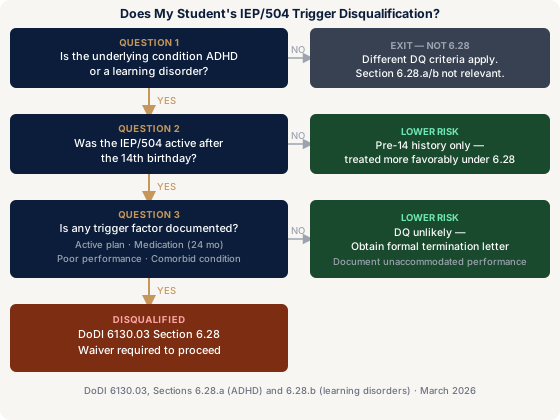
Before writing off the military path, understand what that language actually means. An IEP or 504 plan after age 14 is a disqualifying condition, but only when it exists alongside ADHD or a documented learning disorder like dyslexia. The 504 plan is not the issue. What the 504 plan was for is the issue.
This article covers the exact regulatory text, the 14th birthday rule, what formal termination requires, and why strong academic candidacy is the most important variable in any waiver outcome.
Key Takeaways
- A 504 plan or IEP is not a standalone disqualifier. It triggers disqualification only when linked to ADHD (Section 6.28.a) or a learning disorder (Section 6.28.b).
- The 14th birthday is the regulatory cutoff. Plans fully terminated before age 14 are treated differently than active plans in high school.
- Dormant plans still count. If the 504 is still active in your school's system, DoDMERB sees an active plan, even if your student stopped using accommodations years ago.
- Formal termination requires written documentation from the school. Get the letter. Keep it permanently.
- Waiver outcomes depend on candidacy strength. Academies and ROTC programs advocate for students they want. Unaccommodated academic performance is the strongest evidence.
- ROTC scholarship recipients receive automatic waiver consideration after selection, with significantly more timeline runway than academy applicants.
What the Regulation Actually Says
DoDMERB doesn't disqualify students for having a 504 plan. It disqualifies students for having ADHD or a learning disorder and uses IEP/504 history as evidence of that condition's functional impact. The 504 plan is a marker, not the condition itself. This distinction matters enormously for waiver preparation.
If the Underlying Condition Is ADHD — Section 6.28.a
DoDI 6130.03 lists four separate criteria that trigger disqualification for ADHD. An IEP or 504 plan is just one of them:
"Attention Deficit Hyperactivity Disorder, if with: (1) A recommended or prescribed Individualized Education Program, 504 Plan, or work accommodations after the 14th birthday; (2) A history of comorbid mental disorders; (3) Prescribed medication in the previous 24 months; or (4) Documentation of adverse academic, occupational, or work performance." — DoDI 6130.03, Section 6.28.a
In plain English: DoDMERB reads an active IEP or 504 as documentation that the student cannot function without external support. Each of the four criteria independently triggers disqualification. But medication history, comorbid conditions, and poor academic performance each independently trigger disqualification as well. A student who is off medication, off accommodations, and performing well academically presents a fundamentally different profile than one who checks multiple boxes. That distinction shapes how waiver authorities evaluate the case.
If the Underlying Condition Is a Learning Disorder — Section 6.28.b
Learning disorders follow a similar but not identical structure:
"History of learning disorders after the 14th birthday, including, but not limited to, dyslexia, if any of the following apply: (1) With a recommended or prescribed Individualized Education Program, 504 Plan, or work accommodations after the 14th birthday; (2) With a history of comorbid mental disorders; or (3) With documentation of adverse academic, occupational, or work performance." — DoDI 6130.03, Section 6.28.b
The key difference from ADHD: there is no medication criterion for learning disorders. The threshold is a diagnosis after the 14th birthday combined with any of the three listed factors. A dyslexia diagnosis at age 8 without an active high school IEP or 504 reads very differently than an active plan at age 16.
| Section 6.28.a (ADHD) | Section 6.28.b (Learning Disorders) | |
|---|---|---|
| IEP/504 trigger | After 14th birthday | After 14th birthday |
| Medication criterion | Yes (24 months med-free required) | No |
| Adverse performance trigger | Yes | Yes |
| Comorbid disorders trigger | Yes | Yes |
The table above highlights the structural difference. For families dealing with a learning disorder rather than ADHD, the absence of a medication criterion simplifies one dimension of the waiver equation.
Related: For a complete guide on ADHD and the DoDMERB waiver process, see ADHD and DoDMERB Waivers: An 8-Step Guide.
The 14th Birthday Rule: Why Age 14 Is the Cutoff
Your student was diagnosed with dyslexia at age 9, had a 504 through middle school, and formally exited it at age 13. That history is treated very differently than an active 504 at age 16.
Age 14, roughly the 8th-to-9th grade transition, is the threshold because it speaks to function as a high school student and emerging adult. DoDMERB is asking one question: can this person perform at military standards without accommodation today? Pre-14 history reflects childhood development. Post-14 history reflects the student's capacity to function independently at the level military service demands.
What counts after 14:
- Any IEP or 504 plan in effect after the 14th birthday
- Work accommodations such as extended test time or classroom modifications
- Accommodation use is irrelevant. An active plan counts even if the student never exercises the accommodations
What doesn't automatically count:
- Diagnoses and plans fully terminated before the 14th birthday
- Elementary or middle school history alone, without ongoing high school accommodations
Formal Termination Is Required: Dormant Plans Still Count
Your student stopped using extended test time two years ago. The 504 plan is still active in the school's system. DoDMERB will see an active 504 plan, and that is a disqualifier. The existence of accommodations matters, not whether your student is using them.
How to Formally Terminate a 504 Plan
- Send a written request to the school's 504 coordinator.
- Both parents attend the committee meeting.
- The school evaluates whether the student still qualifies for accommodations.
- Request official written confirmation: effective date, reason for termination, and an explicit statement that no accommodations are in place.
- This document goes directly into the DoDMERB file. Keep it permanently.
IEP Termination Is More Complex
IEP termination requires a formal meeting with the school's special education team. The team must document that the student can succeed in general education without support services. The same documentation principles apply: get the termination in writing, with dates and explicit language confirming no accommodations remain in place.
SAT/ACT Scores Taken With Accommodations
The College Board maintains records of extended time and other testing accommodations. If your student has scores taken with accommodations, consider retaking the test without them. Improvement on subsequent unaccommodated tests creates positive evidence of independent function. A strong score without accommodations directly counters the narrative that your student needs support to perform.
DoDMERB Qualified
Not sure whether your student's IEP or 504 plan needs formal termination before the DoDMERB exam?
We review your student's specific school records and medical history to identify exactly what DoDMERB will see and what steps to take before the exam.
How to Get a Waiver: Candidacy Strength Drives Academy Advocacy
DoDMERB determines disqualification status. The academy or ROTC program decides whether to seek a waiver. These are two different decisions made by two different organizations.
Academies have limited waiver slots. They spend them on candidates they want. A strong student is the one an academy will fight for. Your student's job is to make the academy want them badly enough to use one of those slots. The waiver authority needs to see that granting the waiver carries minimal risk. The academy needs to believe the candidate is worth the effort.
What "strong candidacy" looks like:
- GPA maintained without accommodations, with course rigor including AP and honors
- Strong SAT/ACT scores taken without accommodations
- Leadership positions, varsity athletics, community impact
- Teachers who can speak directly to focus and performance without accommodations
- Clean GPA trajectory after IEP/504 removal showing sustained or improved performance
The candidacy portfolio and the medical file work together. A student with a borderline medical history but an outstanding application gets more advocacy than a marginal candidate with a clean medical record. Admissions offices and waiver authorities communicate. The strength of the overall application determines how hard the academy pushes.
Related: For guidance on building your documentation package, see ADHD and DoDMERB Waivers: An 8-Step Guide.
Academy vs. ROTC: Two Different Waiver Paths
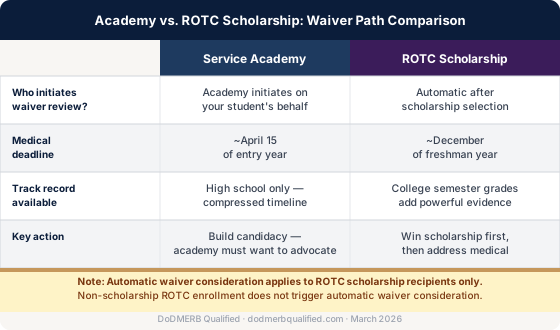
ROTC scholarship recipients are automatically considered for a medical waiver after selection. No separate initiation required. The academy path works differently, and understanding both timelines matters for planning.
Academy Waivers
Academy waivers involve a holistic review. Athletics, leadership, and academics all factor into whether the academy decides to initiate waiver review on your student's behalf. Candidate liaisons can sometimes advocate for strong candidates. Waivers generally need resolution by approximately April 15 of the entry year, which creates a compressed timeline.
ROTC Waivers
Win the scholarship first. Medical qualification happens after selection. ROTC scholarship recipients receive automatic waiver consideration with no separate initiation required.
ROTC students who begin college with a pending waiver have time to build a real-world track record. College semester grades, unaccommodated coursework, and demonstrated function in a demanding academic environment all become waiver evidence. A semester of strong college performance without accommodations is some of the most powerful evidence available. ROTC scholarship recipients have until approximately December of their freshman year to complete medical qualification, giving them significantly more runway than the April 15 deadline academy applicants face.
Frequently Asked Questions
Does having a 504 plan automatically disqualify my student from a military academy?
No. A 504 plan triggers disqualification only when linked to ADHD (Section 6.28.a) or a learning disorder (Section 6.28.b). The plan itself is evidence of impairment, not the disqualifying condition. If the 504 covers a different condition, different criteria apply.
My student had a 504 plan but stopped using it years ago. Does it still count against them?
Yes, if it was never formally terminated. An active plan in the school's system counts as a current accommodation regardless of actual use. Request formal termination in writing and obtain a dated confirmation letter from your school.
What if the 504 was for something other than ADHD or a learning disability, like anxiety or migraines?
The IEP/504 language in Sections 6.28.a and 6.28.b applies only to ADHD and learning disorders. Anxiety and migraines have their own disqualification criteria elsewhere in DoDI 6130.03. The 504 plan may still appear in your student's records, but the regulatory analysis is different.
Can my student get a waiver with an active IEP or 504 plan still in place?
Technically possible, but extremely difficult. An active plan signals ongoing need for accommodation, which directly contradicts the case a waiver needs to make. Terminating the plan and demonstrating unaccommodated performance first creates a far stronger waiver profile.
How soon before the DoDMERB exam should we formally terminate the 504 plan?
As early as possible. Every semester of strong unaccommodated performance after termination strengthens the waiver case. If your student is a sophomore or junior, begin the process now. Waiting until senior year leaves minimal time to build an academic record without accommodations.
My student is applying for ROTC. Is the waiver process different?
Yes. ROTC scholarship recipients receive automatic waiver consideration after selection, with no separate initiation step. They also have until approximately December of freshman year to resolve medical qualification, compared to approximately April 15 for academy applicants. Win the scholarship first, then address the medical process.
DoDMERB Qualified
Need clarity before your student submits medical records?
We help families identify the real disqualifier, spot missing documentation, and build a cleaner DoDMERB strategy before waiver review begins.