Your student wears glasses, and you are holding a prescription that reads -6.50 in one eye and -7.00 in the other. You found something online saying service academies require "perfect vision," and your stomach dropped. Here is what you need to know: wearing glasses or contacts does not disqualify a student from attending a service academy.
DoDMERB evaluates corrected vision through two separate tests, and most students who wear glasses pass both. Understanding those two tests is what this article covers.
Key Takeaways
- Wearing glasses or contacts does not disqualify a student from a service academy. DoDMERB evaluates corrected acuity, not uncorrected.
- All five service academies require vision correctable to 20/20 in each eye for distant acuity.
- A second, independent test limits the underlying prescription: refractive error cannot exceed ±8.00 diopters spherical equivalent and astigmatism cannot exceed 3.00 diopters.
- The spherical equivalent is calculated from both the sphere and cylinder values on the prescription. It is NOT the same as the sphere number alone.
- Pilot and aviation vision standards are a separate, stricter category that applies to career selection after enrollment, not to academy admission itself.
How DoDMERB Evaluates Corrected Vision: Two Separate Tests
Most parents focus on uncorrected acuity, the blurry reading your student gets when the eye doctor asks them to read the chart without any lenses. That number is not what DoDMERB is primarily evaluating. What matters is whether the student can see well enough with correction, and whether the prescription strength itself falls within a defined safe range.
Two independent tests apply to every applicant:
Test 1: Corrected visual acuity. Can the student see 20/20 with glasses or contacts on? This is the test most people picture when they think of a vision exam.
Test 2: Refractive error limits. Is the underlying prescription within DoDMERB's safety thresholds? This test evaluates the strength of the prescription, not how well the student sees while wearing lenses.
Both tests are grounded in DoDI 6130.03, the Department of Defense instruction governing military accession medical standards. Section 6.4.a disqualifies applicants whose distant acuity does not correct to at least 20/40. Section 6.4.d sets the refractive error standard:
"Current refractive error (hyperopia, myopia, astigmatism) in excess of -8.00 or +8.00 diopters spherical equivalent or astigmatism in excess of 3.00 diopters." — DoDI 6130.03-V1, Section 6.4.d
The 20/40 baseline in Section 6.4.a applies to the general DoD population. Section 6.4.b authorizes service academies to set higher requirements, which all five do: each academy requires 20/20 corrected.
Failing either test triggers a disqualification. A student can see 20/20 with glasses and still fail the refractive error test if the underlying prescription exceeds ±8.00 diopters spherical equivalent.
Related: For a full branch-by-branch comparison of vision standards including color vision, see Vision Requirements by Branch: Academy and ROTC Guide.
Test 1: Corrected Visual Acuity — The 20/20 Standard
If your student can see 20/20 with their glasses or contacts, they pass the corrected visual acuity test for USMA, USNA, USAFA, and USMMA. Most students who wear glasses for nearsightedness or moderate astigmatism correct to 20/20 easily. The corrected acuity test is rarely the surprise.
Here is what each academy requires:
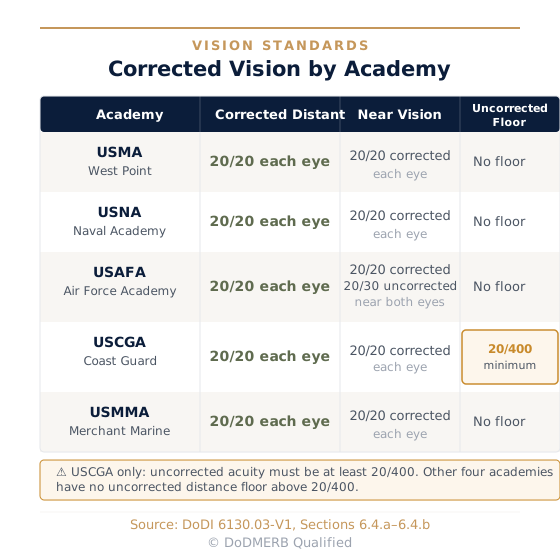
Corrected distant acuity requirement is 20/20 at all five academies. Only USCGA applies an uncorrected distance floor.
For ROTC programs under the DoDI 6.4.a baseline, one eye must correct to 20/20 and the other may be as low as 20/100, making ROTC slightly more forgiving than the academies for the weaker eye.
The 20/400 threshold across all programs means a student with 20/200 uncorrected acuity (a common level of nearsightedness) is not independently disqualified on uncorrected vision for USMA, USNA, USAFA, or USMMA. That student needs to pass the corrected acuity test and the refractive error test described in the next section.
Test 2: Refractive Error Limits — Why the Prescription Number Also Matters
A student who sees 20/20 with glasses can still receive a DoDMERB vision disqualification. The disqualification would not come from how they see with lenses in place, but from the underlying prescription strength exceeding a separate threshold. This is the test that catches families off guard.
DoDI 6130.03 establishes three independent refractive error disqualifiers:
"Current refractive error (hyperopia, myopia, astigmatism) in excess of -8.00 or +8.00 diopters spherical equivalent or astigmatism in excess of 3.00 diopters." — DoDI 6130.03-V1, Section 6.4.d
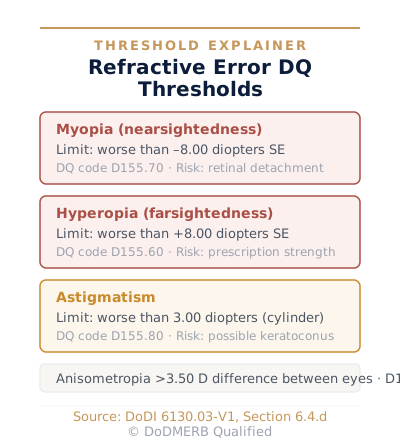
The four refractive conditions that can independently trigger a DoDMERB disqualification, with DQ codes from DoDI 6130.03-V1.
How to Calculate Spherical Equivalent
The formula uses both numbers from the prescription:
SE = sphere + (cylinder ÷ 2)
Three worked examples show the difference between passing and failing:
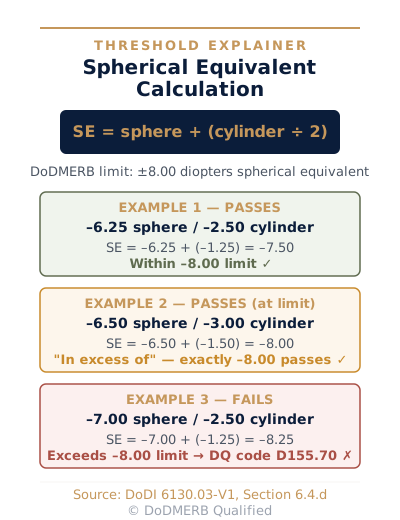
SE = sphere + (cylinder ÷ 2). The sphere number alone does not determine eligibility — the full calculation is required.
Example 1 (passes): -6.25 sphere / -2.50 cylinder SE = -6.25 + (-1.25) = -7.50. Within the -8.00 limit. This is a high myope who clears the threshold.
Example 2 (passes, exactly at limit): -6.50 sphere / -3.00 cylinder SE = -6.50 + (-1.50) = -8.00. The standard says "in excess of," not "equal to or worse than." This passes.
Example 3 (fails): -7.00 sphere / -2.50 cylinder SE = -7.00 + (-1.25) = -8.25. Exceeds the -8.00 limit. Disqualified under DQ code D155.70, even though the sphere alone looks borderline acceptable.
The cylinder value on the prescription represents astigmatism. A cylinder exceeding 3.00 diopters is also independently disqualifying, separate from the SE calculation.
Why the Military Sets These Limits
The refractive error thresholds exist because prescription strength is a proxy for structural eye risk. High myopia, where the eyeball is elongated to produce a strong nearsighted prescription, carries an elevated risk for retinal tears, holes, and lattice degeneration. That structural risk does not disappear when glasses correct the image. A student seeing 20/20 through a -9.00 SE prescription still has an elongated eyeball with the associated retinal vulnerability.
High astigmatism draws separate scrutiny. A large cylinder value can be an early sign of keratoconus, a progressive corneal thinning condition that is disqualifying under DoDI 6130.03, Section 6.3.c. The refractive error limits serve as a first-level screening mechanism for both risks.
DoDMERB Qualified
Not sure whether your student's prescription clears the refractive error threshold?
We review the full prescription, calculate spherical equivalent, and tell you exactly where your student stands before the DoDMERB exam.
When Refractive Error Exceeds the Limit: Waivers and What Reviewers Look For
A refractive error disqualification is one of the most commonly waived vision conditions in the DoDMERB system. Waiver reviewers are not evaluating the prescription number in isolation. They are evaluating whether the retina is healthy and whether the structural risks associated with a high prescription are actually present.
For myopia or hyperopia exceeding ±8.00 SE, waiver reviewers typically request a dilated fundoscopic examination performed by an ophthalmologist. This exam evaluates the retina directly, looking for lattice degeneration, retinal holes, or tears that indicate elevated detachment risk. When the retina is normal, waivers are generally approved up to -10.00 SE. Some waiver authorities have granted approvals at -11.00 SE when the retinal exam shows no abnormalities at all.
For astigmatism exceeding 3.00 diopters, reviewers request corneal topography, a detailed contour map of the corneal surface. The topography is reviewed for signs of keratoconus or other corneal ectasia. A normal topography supports a waiver for astigmatism up to approximately 5.00 diopters.
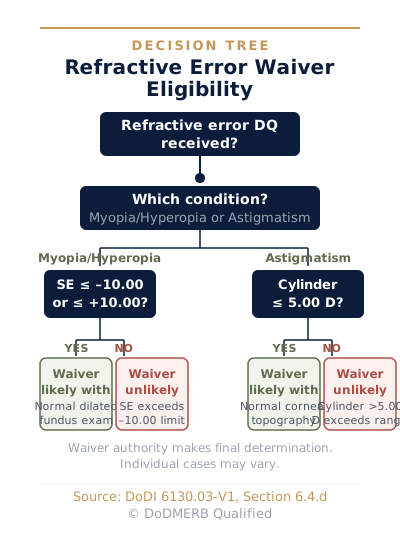
Waiver eligibility depends on condition type and supporting exam results. Waiver authority makes the final determination.
The dilated fundoscopic exam is the single most important document in a high-myopia waiver packet. It must be performed by an ophthalmologist (an M.D. or D.O. with ophthalmic specialty training), not an optometrist. Ophthalmologists are trained to evaluate and document retinal pathology at the clinical level waiver authorities require for this review.
Related: For everything about refractive surgery timing and DoDMERB implications, see LASIK and PRK: DoDMERB Requirements.
Corrected Vision vs. Aviation Vision: A Different Conversation Entirely
Parents who look up Air Force pilot vision requirements find 20/70 uncorrected as a qualifying standard, then assume that number applies to getting into USAFA. It does not. Academy admission vision standards and aviation career vision standards are two separate medical determinations evaluated at different points in a student's career.
For academy admission, the questions are: does corrected acuity reach 20/20, and does the refractive error fall within ±8.00 SE? Uncorrected acuity is essentially irrelevant as long as it is better than 20/400.
For aviation career selection after enrollment, an additional uncorrected acuity requirement applies:
| Branch | Uncorrected Acuity for Pilot Selection | Corrected Requirement |
|---|---|---|
| Air Force | No worse than 20/70 | 20/20 |
| Army | No worse than 20/50 | 20/20 |
| Coast Guard | No worse than 20/50 | 20/20 |
| Navy | No specific uncorrected floor at initial accession | 20/20 each eye |
These aviation figures come from each service's aeromedical regulations (for example, NAVMED P-117 and AFI 48-123), not the base DoDI 6130.03, and are updated periodically. Confirm the current flight-physical standard with the commissioning source before relying on a specific number.
A student with -5.00 SE and 20/200 uncorrected can attend USAFA and pursue any non-flying career path. If they later want to pursue pilot training, a LASIK or PRK procedure through the academy's ophthalmic program could bring uncorrected acuity into aviation-eligible range, provided the pre-surgical prescription was within the required limits. That is a post-enrollment decision, not an admissions hurdle.
Corrected Vision and LASIK: What Changes After Surgery
LASIK does not improve a student's admission eligibility if they already pass both corrected acuity and refractive error tests. A student who sees 20/20 with glasses and has SE within ±8.00 diopters has nothing to gain from LASIK before applying, and something significant to lose if the timing is wrong.
Corneal refractive surgery performed within 180 days of the DoDMERB accession exam is automatically disqualifying under DoDI 6130.03, Section 6.3.c. There is no waiver available for the timing violation. The student must wait the full 180 days and reschedule the exam.
Beyond timing, the pre-surgical prescription becomes part of the permanent record. DoDI 6130.03 explicitly disqualifies applicants whose pre-surgical refractive error exceeded ±8.00 SE:
"Pre-surgical refractive error in either eye exceeded a spherical equivalent of +8.00 or -8.00 diopters" is disqualifying. — DoDI 6130.03-V1, Section 6.3.c.(3)(a)
A student whose pre-op SE was -9.00 diopters is still disqualified after successful LASIK, because the pre-surgical prescription itself exceeded the limit. Surgery corrects how the student sees; it does not change what the prescription was before the procedure.
LASIK is primarily relevant as a post-enrollment option for students pursuing aviation billets. Service academies routinely offer refractive surgery to enrolled students in their third year, when vision has stabilized and students meet the FDA approval age requirement, specifically for those pursuing pilot or other aviation career paths that require better uncorrected acuity.
Frequently Asked Questions
Can my student attend a service academy if they wear glasses?
Yes. Wearing glasses or contacts is not a disqualifier. DoDMERB evaluates two things: whether the student can see 20/20 with correction, and whether the underlying prescription falls within refractive error limits (±8.00 diopters spherical equivalent, 3.00 diopters astigmatism). A student who passes both tests faces no vision-related barrier to admission regardless of prescription strength.
What is the corrected vision requirement for West Point, the Naval Academy, and the Air Force Academy?
All three require distant visual acuity correctable to 20/20 in each eye. Near vision: USMA and USNA require 20/20 corrected near acuity in each eye. USAFA requires 20/20 corrected near and 20/30 uncorrected near. The Coast Guard Academy also requires 20/20 corrected distant but adds a separate uncorrected distant floor of 20/400 that does not apply to the other four academies.
My student sees 20/20 with glasses but has a high prescription. Could they still be disqualified?
Yes, if the refractive error test fails. The corrected acuity test is only one of two independent tests. The refractive error test checks spherical equivalent (SE = sphere + cylinder ÷ 2) against a ±8.00 diopter limit. A student who sees 20/20 through a -9.00 SE prescription passes acuity but fails refractive error. See the section above for the formula and worked examples.
What is spherical equivalent and how do I calculate it?
Spherical equivalent combines nearsightedness or farsightedness with astigmatism into a single number. The formula: SE = sphere + (cylinder ÷ 2). Example: -6.25 sphere / -2.50 cylinder gives SE = -7.50, which passes. A prescription of -7.00 sphere / -2.50 cylinder gives SE = -8.25, which fails. The raw sphere number alone is not sufficient to determine eligibility.
Does astigmatism disqualify you from a service academy?
Not automatically. Astigmatism is disqualifying only when the cylinder value on the prescription exceeds 3.00 diopters. Mild to moderate astigmatism (cylinder under 3.00) does not trigger a disqualification. Astigmatism between 3.00 and approximately 5.00 diopters is disqualifying but potentially waivable if corneal topography shows no signs of keratoconus. The cylinder value also factors into the spherical equivalent calculation, which has its own separate ±8.00 limit.
Are vision waivers available when refractive error exceeds the limit?
Yes. Refractive error disqualifications are among the most commonly waived vision conditions. For myopia or hyperopia exceeding ±8.00 SE, waivers are generally available up to approximately -10.00 SE when a dilated fundoscopic exam confirms a healthy retina. For astigmatism exceeding 3.00 diopters, waivers typically extend to 5.00 diopters with normal corneal topography. The waiver authority for each service branch makes the final determination.
Do pilot vision standards apply to getting into USAFA or Annapolis?
No. Pilot and aviation career standards are separate from academy admission standards and apply only to career selection after enrollment. A student can attend any service academy regardless of uncorrected visual acuity, provided corrected acuity reaches 20/20 and refractive error falls within the DoDI limits. Aviation career eligibility is evaluated through a flight physical after enrollment for students who pursue pilot billets.
The appearance of U.S. Department of Defense (DoD) visual information does not imply or constitute DoD endorsement.