Your student ran varsity cross-country all four years of high school. They haven't touched an inhaler in two years. Then you open their medical chart and see three words: exercise-induced bronchospasm.
DoDI 6130.03 names exercise-induced bronchospasm explicitly alongside asthma. If symptoms or medication use occurred after age 13, it triggers a disqualification on paper. This article explains what the standard says, why the "no formal asthma diagnosis" argument fails, when waivers succeed, and how to build the strongest case for academy or ROTC scholarship applicants.
Key Takeaways
- DoDI 6130.03 names exercise-induced bronchospasm explicitly. It is disqualifying if symptoms or medication use occurred after the 13th birthday, whether or not a formal asthma diagnosis exists.
- A single inhaler prescribed for bronchitis is different from EIB; DoDMERB physicians review primary clinical records and recognize the distinction.
- The strongest waiver profiles combine normal spirometry, no significant reversibility after bronchodilator, a negative methacholine challenge, and symptom-free high-intensity athletics off all medication.
- Stopping inhaler use before the exam to "clean up" records is dangerous and backfires when pharmacy logs are cross-checked.
- ROTC scholarship applicants have until approximately December of their freshman year to complete DoDMERB, significantly more runway than the Academy April 15 deadline.
What DoDI 6130.03 Actually Says About Exercise-Induced Bronchospasm
Exercise-induced bronchospasm is not a gray area in the regulation. DoDI 6130.03 names EIB, reactive airway disease, and asthmatic bronchitis in the same criterion as asthma. The standard does not treat these as separate conditions with separate outcomes. They all fall under the same disqualifying section.
Here is the relevant language from the regulation:
"History of airway hyper responsiveness including asthma, reactive airway disease, exercise-induced bronchospasm or asthmatic bronchitis, after the 13th birthday. (1) Symptoms suggestive of airway hyper responsiveness include, but are not limited to, cough, wheeze, chest tightness, dyspnea, or functional exercise limitations after the 13th birthday. (2) History of prescription or use of medication (including, but not limited to, inhaled or oral corticosteroids, leukotriene receptor antagonists, or any beta agonists) for airway hyper responsiveness after the 13th birthday." — DoDI 6130.03, Section 6.10.e
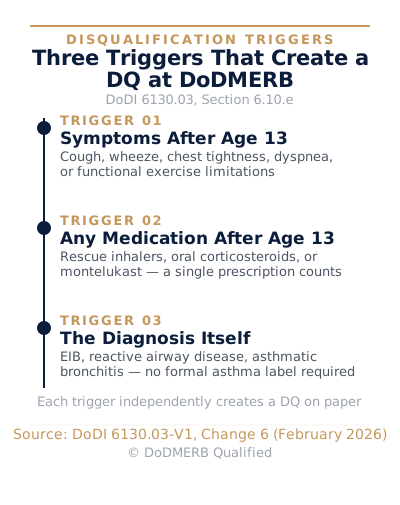
In plain English, three triggers create a disqualification on paper:
- Symptoms after age 13. Wheezing, chest tightness, coughing with exercise, or any functional exercise limitation documented after the 13th birthday.
- Any medication prescribed for airway hyperresponsiveness after age 13. Rescue inhalers, maintenance inhalers, oral corticosteroids, and leukotriene receptor antagonists like montelukast. A single prescription counts.
- The diagnosis itself. Any chart notation of asthma, EIB, reactive airway disease, or asthmatic bronchitis after age 13.
The standard does not require a formal "asthma" label. A chart note reading "exercise-induced bronchospasm" triggers the same criterion. The section is written broadly enough that any airway hyperresponsiveness documentation after age 13 applies.
This is the DQ trigger at DoDMERB. It is not the waiver denial. The waiver process is handled separately by the service-specific waiver authority, and the standards for approval differ from the standards for the initial qualification decision.
After reading this section, you understand exactly which three triggers create a DQ on paper and why the "no formal asthma diagnosis" argument does not protect your student.
EIB vs. Classic Asthma — Why the Diagnosis Label Matters Less Than You Think
Your student's chart may say "reactive airway disease" rather than "asthma," but the DQ standard treats them identically. EIB and classic asthma share the same criterion under Section 6.10.e. The label on the chart is irrelevant to the initial disqualification decision.
However, the distinction matters significantly for the waiver. Exercise-induced bronchospasm in athletes is a recognized clinical entity. Research shows that up to 20% of the general population has some degree of EIB without a formal asthma diagnosis. A study of US Army recruits found that 7% tested positive for EIB, yet it did not hinder their performance in basic training.
A student whose bronchospasm was triggered only by exercise, never occurred at rest, and never presented as spontaneous flares has a different clinical profile than a student with persistent asthma. If that student has been off all medications for a year or more, objective pulmonary testing can demonstrate genuine resolution.
Contrast that with classic persistent asthma: resting bronchospasm, spontaneous flares unrelated to exertion, ongoing medication dependency, and nighttime symptoms. Waiver reviewers examine the clinical trajectory across the full medical history, not a snapshot from a single visit note. The pattern of improvement over time is what separates a resolved condition from a managed one.
The practical takeaway: the label did not protect your student from the DQ, but the clinical pattern behind the label is exactly what the waiver authority evaluates.
Three EIB Scenarios DoDMERB Actually Sees — and How Each Plays Out
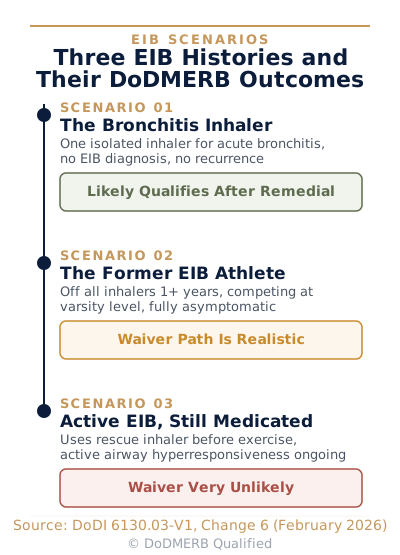
Not every EIB history follows the same path through DoDMERB. The outcome depends on what the medical records show, how recently medications were used, and whether objective testing supports genuine resolution. Here are the three most common scenarios.
Scenario 1: The Bronchitis Inhaler
Your student got an inhaler at 16 during a respiratory infection. The chart says "bronchitis." No inhaler before that episode and none since.
DoDMERB physicians review primary clinical records. If the diagnosis is bronchitis and the inhaler was prescribed as short-term treatment for an acute infection, this is recognized as standard care.
The key is what the chart documents. A bronchitis diagnosis with a short-duration inhaler prescription carries a different risk profile than an EIB diagnosis with a rescue inhaler for exercise-related wheezing. One caveat: if the student repeatedly presented with wheezing requiring inhalers across multiple visits, that pattern signals airway hyperresponsiveness regardless of any individual visit label.
Likely outcome: DoDMERB issues a Remedial requesting primary clinical records. If those records confirm one isolated bronchitis episode with appropriate short-term treatment, DoDMERB will likely qualify.
Scenario 2: The Former EIB Athlete Who Genuinely Outgrew It
Your student had documented EIB at ages 14 and 15, used a rescue inhaler intermittently, and stopped at 16. Now 17 or 18, they compete in varsity athletics and are fully asymptomatic.
This is the most common scenario families describe, and it has a realistic waiver path. DoDMERB will disqualify on paper. The waiver authority then reviews the case, looking for time since last medication use, objective pulmonary function data demonstrating no current airway hyperresponsiveness, and evidence of high-intensity athletic activity without symptoms.
The longer since the last inhaler use and the cleaner the objective testing, the stronger the case. A student two years removed from their last inhaler with normal spirometry, no bronchodilator reversibility, and a negative methacholine challenge presents a compelling profile.
Scenario 3: Active EIB Still Managed by Medication
Your student still uses a rescue inhaler periodically before sports or intense physical activity.
Current, active EIB managed by medication is very unlikely to receive a waiver for line officer commissioning. The waiver standard requires evidence of genuine resolution, not controlled management. A student who needs pre-exercise albuterol to avoid bronchospasm has active airway hyperresponsiveness by definition.
The constructive path here is not a waiver application. It is a conversation with a physician about optimizing treatment toward genuine resolution, then reassessing timing for the commissioning medical process.
After reading this section, you can identify which scenario describes your student's situation and understand the realistic path for each.
DoDMERB Qualified
Not sure which EIB scenario applies to your student's history?
Our team reviews your student's specific medication timeline, diagnosis records, and athletic history against DoDMERB and waiver authority standards, so you know what to expect before the exam.
Related: For a full explanation of what happens after a DQ, see the DoDMERB Waiver Process: Complete Guide.
The Waiver Testing Path — What Spirometry and Methacholine Results Actually Show
Normal spirometry is a good sign, and it is not the final word. Most elite athletes with EIB have completely normal resting spirometry. The baseline test does not capture the condition because it measures lung function at rest, not under challenge. Waiver authorities often request additional testing beyond what was performed at the DoDMERB exam.
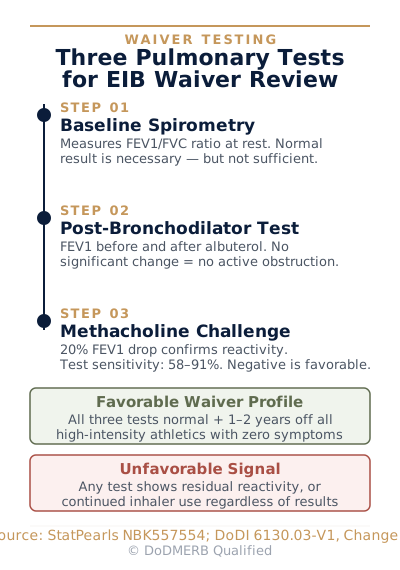
Start the pulmonary evaluation with current pre/post-bronchodilator spirometry and complete clinical records. DoDMERB or the waiver authority may then request a methacholine challenge:
Baseline spirometry measures FEV1 and FVC (forced vital capacity). A normal FEV1/FVC ratio at rest indicates normal lung function when the airways are not being challenged. This is a necessary starting point but not sufficient evidence of resolution.
Post-bronchodilator spirometry measures FEV1 before and after administration of a bronchodilator like albuterol. If baseline function is normal and does not change significantly after the bronchodilator, it suggests no active reversible obstruction. The airways are not constricted and therefore do not "open up" with medication.
Methacholine challenge testing involves breathing increasing concentrations of methacholine, a substance that triggers bronchospasm in hyperresponsive airways. A 20% drop in FEV1 during the test confirms airway reactivity. Test sensitivity ranges from 58% to 91% depending on methodology, so a negative result is favorable but not absolute proof.
The favorable waiver profile combines all three: normal FEV1/FVC at rest, no significant reversibility with bronchodilator, negative methacholine challenge, high-intensity athletics with zero symptoms, and no inhaler use for at least one to two years.
The unfavorable profile is any of these tests showing residual reactivity, or continued inhaler use regardless of test results.
After reading this section, you understand what each test measures, what favorable results look like, and why normal spirometry alone may not close the waiver case.
The Integrity Trap — Why Stopping Medication Before the Exam Always Backfires
Some families consider stopping inhaler use before the exam to make the medical record look cleaner. This approach is both dangerous and ineffective.
It is dangerous because EIB is a real physiological condition. Stopping medication without medical guidance can result in a severe bronchospasm episode that lands your student in the emergency room. That ER visit creates new medical documentation worse for the waiver case than the original inhaler history.
It is ineffective because pharmacy records can be requested as part of a Remedial or by the waiver authority during waiver review. Those logs show every prescription filled: date, medication, quantity, and refill history. A student who filled a rescue inhaler regularly and then stopped abruptly three months before the exam creates a suspicious gap, not a clean record.
Genuine resolution looks different from manufactured silence. A student who used an inhaler through age 15, tapered appropriately under physician supervision, achieved symptom-free status by 16, and then has two years of high-intensity athletics without medication has a believable clinical narrative. A student who filled an inhaler every three months for two years and then stopped cold has a gap that raises questions.
Accuracy on the DD Form 2807-2 is a foundational expectation for commissioning. Future officers demonstrate integrity from the very beginning of the process, starting with their own medical history.
After reading this section, you understand why proper medical management, not record suppression, is the only effective path to a successful waiver.
Organizing Your Student's Documentation Before DoDMERB Issues a Remedial
Families who have records organized at home respond to Remedials faster and get decisions faster. DoDMERB does not ask for records at the initial physical. Submit only when DoDMERB issues a Remedial request specifying what they need.
Here is what to gather now so you are ready:
Medication and Prescription Records
- Pharmacy records showing all inhaler prescriptions: date, medication name, last fill date
- Records of any oral corticosteroid prescriptions for respiratory symptoms
Clinical Records
- Primary clinical notes (not patient portal summaries) from every visit documenting breathing symptoms, wheezing, or inhaler use
- Any emergency or urgent care records for respiratory episodes
Pulmonary Testing
- Baseline spirometry results, including post-bronchodilator if available
- Methacholine challenge results if previously performed
Physician Documentation
- Letter from treating physician or pulmonologist documenting: current symptom status, last medication use, current activity level, and any functional restrictions
Request primary clinical records directly from the provider's office. Do not submit patient-portal printouts unless the remedial request expressly allows them.
After reading this section, you have a specific checklist and understand to keep records organized at home rather than proactively submitting them.
The Bottom Line
Exercise-induced asthma and military commissioning are not mutually exclusive, but the path requires honest medical management and objective documentation. DoDI 6130.03 disqualifies EIB on paper. That is not the end of the process. Waivers exist, are granted regularly, and the standards for approval are knowable.
The students who succeed are not the ones who concealed their medication history. They are the ones who treated their condition properly, achieved genuine resolution, and showed a clean objective picture to the waiver authority.
If your student has a remote EIB history, has been off inhalers for a year or more, and is competing at high intensity without symptoms, start organizing the documentation now. Gather pharmacy records, clinical notes, and pulmonary testing results. Have them ready at home for when the Remedial arrives.
If your student still has active EIB, the right step is a conversation with a physician about the path to genuine resolution. The timeline matters, and both Academy and ROTC pathways have specific deadlines that frame how much runway your student has.
Related: For a full comparison of what triggers an automatic DQ versus what leads to a waiver review, see Asthma After Age 13: DoDMERB Waiver Guide.
Frequently Asked Questions
Is exercise-induced bronchospasm the same as asthma for DoDMERB?
For DoDMERB purposes, yes. DoDI 6130.03 Section 6.10.e lists exercise-induced bronchospasm, reactive airway disease, and asthmatic bronchitis in the same criterion as asthma. Any of these triggers a DQ if symptoms or medication use occurred after the 13th birthday.
My student got one inhaler for bronchitis at age 16. Is that an automatic DQ?
Not automatically. DoDMERB physicians review primary clinical records. If the chart shows a bronchitis diagnosis and the inhaler was short-term treatment for an acute infection, that is recognized as standard care. The documentation of the bronchitis diagnosis is what matters.
My student's spirometry was normal. Does that clear the EIB history?
Normal resting spirometry is a positive sign but not sufficient by itself. Most athletes with EIB have normal spirometry at rest. Waiver authorities typically also require post-bronchodilator testing and may request a methacholine challenge to assess actual airway reactivity.
How long does my student need to be off inhalers before a waiver is realistic?
Waiver authorities consistently look for a meaningful period of genuine stability. Typically one to two or more years of no inhaler use combined with high-intensity athletic activity and zero symptoms during that time form the expected profile.
Can ROTC applicants get more time to resolve an EIB DQ than Academy applicants?
Yes. Academy medical qualification must be resolved by approximately April 15 of entry year. ROTC scholarship recipients have until approximately December of their freshman year. That additional runway is significant for students who need time for testing, physician letters, or further stabilization.
Should my student disclose childhood EIB if there have been no symptoms since age 12?
DoDI 6130.03 Section 6.10.e applies to airway hyperresponsiveness after the 13th birthday. If all documented EIB occurred before age 13 with no symptoms, medications, or medical visits after that date, it falls outside the disqualifying criterion. Review medical records carefully against the age threshold before completing DD Form 2807-2.
Does active EIB ever receive a waiver for Academy or ROTC commissioning?
Rarely for line officer programs. The waiver standard requires evidence that airway hyperresponsiveness has genuinely resolved, not that it is being managed. If your student still uses an inhaler, the productive path is medical management toward genuine resolution before pursuing waiver consideration.