Your child has a migraine history and a service academy or ROTC scholarship offer on the table, and you just learned DoDMERB might disqualify them. Take a breath. The picture is more navigable than the forums make it sound.
DoDMERB evaluates headache history under DoDI 6130.03, Section 6.26. The standard uses a 24-month look-back with three independent triggers. Any one is sufficient for a disqualification, but a DQ is not the end of the road.
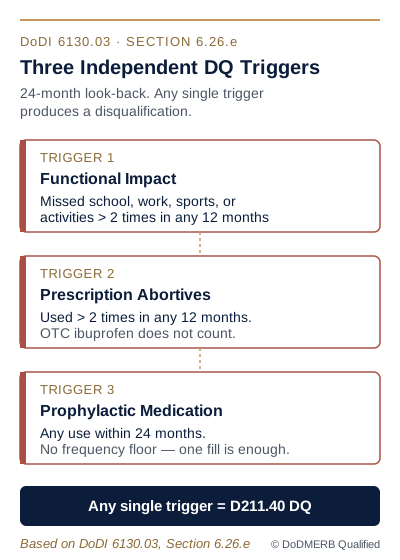
The three triggers under 6.26.e are functional impact (school, work, or sports missed more than twice in any 12-month period), prescription abortive medications used more than twice in any 12-month period, and any use of prophylactic (preventive) medication or therapy.
A migraine DQ is a starting position, not a verdict.
This guide covers what the regulation says, how DoDMERB distinguishes regular from complex migraine, the medication question every parent asks, what a strong waiver looks like, and the documentation to pull this week.
Key Takeaways
- The DoDI 6130.03 headache standard uses a 24-month look-back with three independent triggers, and any one is sufficient for a DQ
- Prophylactic medication has no frequency floor; any use within 24 months triggers the DQ regardless of how few headaches your child had
- Visual-only aura (scotoma) does not make a migraine complex; that carve-out is written into the regulation
- Do not stop preventive medication for DoDMERB optics; the pharmacy log is permanent and premature discontinuation tends to create rebound migraines
- The strongest waiver narrative is physician-documented discontinuation, 12 or more months stable, supported by a current neurologist letter and a 3 to 4 year pharmacy log
- A DQ under D211.40 is routinely waiverable; D211.41 (complex migraine) carries a meaningfully higher bar
What DoDI 6130.03 Actually Says About Migraine History
The regulation is more specific than forum threads suggest, and the specificity is what makes the waiver path navigable. Every clause matters.
The 24-Month Look-Back Window
Section 6.26.e is the standard headache disqualifier. It reads:
"History of headaches within the previous 24 months that: (1) Were severe enough to cause the individual to miss work, school, sports, or other activities more than twice within 12 months; (2) Required prescription medications more than twice within 12 months; (3) Involved the use of prophylactic medication or therapy." — DoDI 6130.03, Section 6.26.e
The reviewer looks at the past 24 months and checks each condition independently. Any single trigger that fires produces a disqualification. A child who never missed a day of school and never used a prescription abortive can still trigger the DQ if she filled one prophylactic prescription inside the window.
Three Independent DQ Triggers
| DQ Trigger | Threshold | Common Misread |
|---|---|---|
| Functional impact | Missed work, school, sports, or activities more than twice in any 12-month period within the window | "She only missed two days total" misses the point; the standard counts any 12-month stretch, not the total across 2 years |
| Prescription abortives | Used more than twice in any 12-month period within the window | OTC ibuprofen does NOT count; only prescription medications do |
| Prophylactic medication | Any use within 24 months | No frequency floor; one fill of topiramate, propranolol, or any CGRP inhibitor is sufficient |
Complex Migraine and Cluster Headaches: Two Additional DQ Tracks
Two adjacent provisions create separate DQ tracks for less common presentations.
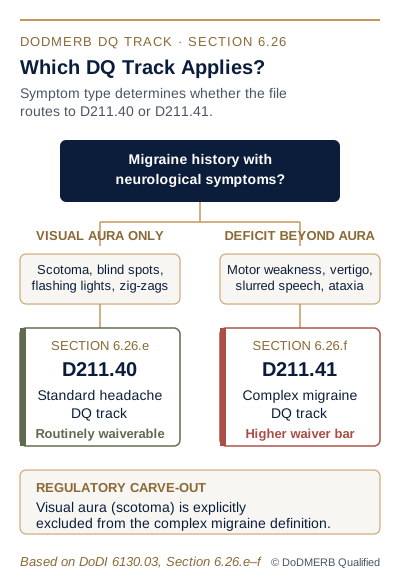
"History of complex migraines associated with neurological deficit other than scotoma." — DoDI 6130.03, Section 6.26.f
"History of cluster headaches." — DoDI 6130.03, Section 6.26.g
These provisions operate independently of 6.26.e. A candidate can be qualified under 6.26.e and still trigger 6.26.f, or vice versa. Each maps to its own DQ code.
DQ Codes to Know
- D211.40 corresponds to 6.26.e, the standard headache DQ
- D211.41 corresponds to 6.26.f, complex migraine
- D211.42 corresponds to 6.26.g, cluster headaches
After this section, you should be able to match your child's specific headache record against the three 6.26.e triggers and identify which DQ track applies.
Regular Migraine vs. Complex Migraine: Why the Distinction Matters
Not every migraine with aura is a complex migraine, and the difference between the two changes everything about the waiver review. Parents often arrive convinced their child is in the harder category when the regulation places her in the more waiverable one.
Regular Migraine: The 6.26.e Path (D211.40)
D211.40 is the most common DoDMERB migraine track and the most waiverable. It captures the typical adolescent presentation: throbbing unilateral headache, light and sound sensitivity, sometimes nausea, sometimes visual aura.
If your child's last qualifying event under 6.26.e fell outside the 24-month window, she may not trigger a DQ at all.
Complex Migraine: The 6.26.f Path (D211.41)
Complex migraine is a narrower category: migraine associated with neurological deficit other than scotoma. Examples include hemiplegic migraine (motor weakness on one side of the body), basilar migraine (vertigo, double vision, slurred speech, ataxia, altered consciousness), and migraine with sensory or speech disturbance beyond visual aura.
Reviewers treat 6.26.f conditions in the sudden-incapacitation category alongside seizures. An officer experiencing a hemiplegic episode or brainstem symptoms in the cockpit, on a ship, or in a tactical environment is a risk to herself and others. The bar is higher for that reason.
D211.40 vs. D211.41 at a Glance
| D211.40 | D211.41 | |
|---|---|---|
| DoDI section | 6.26.e | 6.26.f |
| Trigger | Frequency or prophylactic criteria | Neurological deficit beyond scotoma |
| Typical features | Headache, light sensitivity, nausea; visual aura allowed | Motor weakness, brainstem symptoms, altered consciousness |
| Waiver review depth | Standard | Deep, categorized with seizures |
| Qualitative waiver odds | Often favorable with clean documentation | Materially higher bar |
Cluster Headaches (6.26.g, D211.42)
Cluster headaches are mechanistically distinct from migraine and uncommon in adolescents. They produce excruciating unilateral pain in cyclical patterns, often around the eye. A cluster diagnosis is reviewed on its own track under 6.26.g.
After this section, you should know which DQ track applies to your child's diagnosis and whether visual aura changes that analysis.
The Medication Question: Should Your Child Stop Preventive Meds?
Do not stop your child's preventive migraine medication to clean up the DoDMERB record. This is the most common parent question at this stage and the most consequential mistake.
The pharmacy log captures every fill for years. Stopping today does not erase yesterday's prescription; it only changes the clinical picture going forward, and almost always in the wrong direction.
Why the Cleanup Instinct Backfires
Three independent mechanisms make hasty discontinuation hurt the waiver case.
First, the pharmacy log is permanent. Any chain pharmacy can produce a five-year prescription history. Last year's topiramate fill is not going anywhere.
Second, if the child medically needs the medication, stopping it demonstrates the condition is not stable. Breakthrough migraines on a pulled prescription produce exactly the opposite of what the reviewer wants to see.
Third, abrupt discontinuation often causes rebound headaches. Those become new data points inside the 24-month window. A candidate who was stable under treatment can accumulate three migraine-related visits in the months after stopping, each stamped with a date.
What the Right Path Looks Like
The strong waiver story is physician-documented discontinuation. In the chart it reads roughly: physician and patient mutually agreed to discontinue the prophylactic, with a clinical rationale documented in the note, followed by 12 or more months off medication with minimal or zero migraines, no abortive prescriptions in that window, and no functional impact at school or in sports.
That story takes time to build. It cannot be reverse-engineered in the weeks before a DoDMERB exam.
When Discontinuation Is the Right Answer
If the neurologist independently believes a trial off medication is clinically appropriate, that is a legitimate decision. The typical threshold is migraine frequency under four days per month for at least three consecutive months.
The key word is independently. If the neurologist is asked to discontinue purely for DoDMERB optics, the reviewer will see that pattern in the records.
DoDMERB Qualified
Not sure whether your child's migraine history meets the DoDMERB standard?
We review your student's specific medical history against DoDI 6130.03 and identify where the waiver case is strong and where it needs work.
After this section, you should have a clear position on whether your child's current treatment status requires a conversation with their neurologist before the DoDMERB exam.
What a Strong Migraine Waiver Looks Like
A strong migraine waiver is a paper trail, not an argument. Waivers are decided on documentation. The reviewer reconstructs a clinical story from records and looks for a coherent trajectory. Your job is to make sure that trajectory is visible on the page.
The Documented Discontinuation Path
The pattern reviewers respond to most consistently:
- A neurologist visit in which physician and patient mutually agreed to discontinue the prophylactic, with the rationale captured in the note
- 12 or more months off medication with minimal or zero migraines
- No abortive prescriptions in that window
- No functional impact at school, work, or in athletic activities
- A current neurologist letter summarizing the diagnosis, treatment trajectory, discontinuation, and present clinical status
That five-element pattern is not a guarantee, but it is what the strongest waiver files look like.
Where Your Child Sits: A Case Spectrum
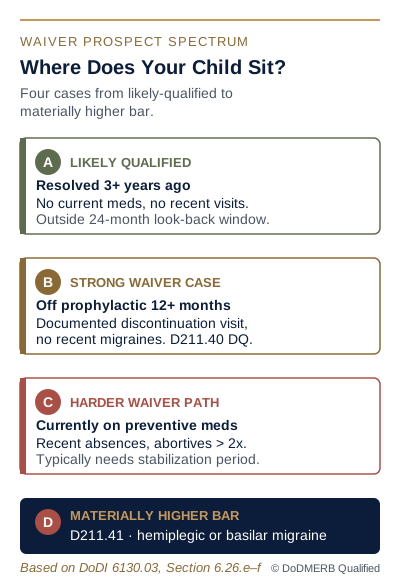
Most candidates fall somewhere on a spectrum:
- Case A: Migraines resolved 3 or more years ago, no current medications, no recent visits or prescriptions. Likely qualified without a waiver under the 24-month look-back.
- Case B: Off preventive medication for 14 months under neurologist guidance, with the discontinuation visit documented and no recent migraines. DQ generated, but the waiver case is strong.
- Case C: Currently on preventive medication, with school absences in the past 12 months and abortives used more than twice in that period. DQ generated, harder waiver path, typically requires a stabilization period before the case improves.
- Case D: Hemiplegic or basilar migraine with motor or brainstem deficits in the documented history. Falls under D211.41, materially higher bar, requires clear imaging and specialist evaluation.
Two outcomes illustrate the variability: an Army ROTC candidate with a D211.40 DQ secured a waiver in roughly four weeks once the neurologist and pediatrician letters were in the file. An Air Force ROTC candidate with infrequent migraines was denied within a week despite a clinical picture that, on paper, looked similar.
A 2006 military outcomes study of enlisted headache waiver recipients followed 174 service members and found no statistically significant difference in retention compared to 522 matched controls (p=0.91). No equivalent officer-accession dataset exists; this is the best available published evidence on long-term outcomes for headache waiver recipients. — Military Medicine, 2006
After this section, you should be able to place your child's current situation on the case spectrum and have a realistic picture of waiver odds.
Documentation to Pull Before You Submit
When the waiver authority opens the file, they will request the same set of records every time. Pull them now. Waiver review timelines compress when documentation is already assembled.
Records to Gather
- Pharmacy log covering the past 3 to 4 years, with every fill, dose, and refill (ask for 5 years to be safe)
- All migraine-related visit notes from every provider: primary care, neurology, urgent care, and emergency department
- The specific visit note where physician and patient agreed to discontinue preventive medication, flagged for the reviewer
- Current neurologist letter summarizing diagnosis, treatment trajectory, current status, and prognosis
- School attendance records covering any migraine-related absences, or a letter from the school confirming no absences
- Any imaging studies (MRI, CT) ordered during the migraine workup
Keep these records at home. Do not send anything to DoDMERB unless a Remedial request specifically asks for it.
The Pharmacy Log: What It Is and How to Get It
Any chain pharmacy (CVS, Walgreens, Walmart, Costco, regional grocery chains) will produce a prescription history on request. The request is usually free and turned around the same day. Ask for 5 years. Reviewers focus on the 3 to 4 year window most relevant to the look-back, but the broader log answers questions before they arise.
If your child has used multiple pharmacies, request a log from each. Better that you assemble the complete picture first.
Service Waiver Authorities
Different services route waiver decisions to different authorities, and those authorities apply different patterns to migraine cases.
| Service | Waiver Authority | Notes |
|---|---|---|
| USNA / NROTC | Bureau of Naval Medicine and Surgery (BUMED) | Reasonable on D211.40 |
| USMA / Army ROTC | U.S. Army Cadet Command Surgeon | Most accommodating for D211.40 |
| USAFA / AFROTC | Air Education and Training Command Surgeon General | Tighter for flight-status considerations |
| USCGA | Academy Medical Review Board | Strictest historically |
Related: For the complete DoDMERB waiver process from DQ to decision, see The DoDMERB Waiver Process: A Complete Guide.
After this section, you should have a checklist you can begin working through this week, before the DoDMERB exam is scheduled.
Frequently Asked Questions
Is a migraine automatically disqualifying for DoDMERB?
No. The standard applies a 24-month look-back. Migraines that resolved more than 24 months ago with no prescription use may not trigger a DQ. A recent history meeting the 6.26.e criteria does produce a DQ, but that DQ is routinely waiverable.
Can my child get a waiver for DoDMERB migraine history?
Yes, routinely. Waiver strength depends on documentation, treatment stability, and current medication status. Published military outcomes research found no difference in retention between headache waiver recipients and matched controls (p=0.91).
Should we stop my child's preventive migraine medication before DoDMERB?
No, not for application optics. The pharmacy log captures every fill for years. Premature discontinuation often causes rebound headaches that become new data points inside the window.
Does migraine with aura count as complex migraine under DoDMERB?
Only if the aura involves more than visual disturbance. DoDI 6.26.f explicitly excludes scotoma (visual aura) from the complex migraine definition. A child with visual-only aura is evaluated under 6.26.e, not 6.26.f.
What records does the DoDMERB waiver authority ask for?
Pharmacy log covering 3 to 4 years, all migraine-related visit notes, the specific visit where preventive medication was discontinued, a current neurologist letter, and school attendance records.
Why did Air Force deny my child's waiver while another service might grant it?
Service waiver authorities apply different risk tolerances. Air Force and AFROTC reviews are typically tighter for flight-status considerations. Army ROTC is generally more accommodating. The same record can produce different outcomes across services.
What is the difference between DQ code D211.40 and D211.41?
D211.40 is the standard headache DQ under 6.26.e, governed by the 24-month look-back. D211.41 is the complex migraine DQ under 6.26.f, reserved for migraines with neurological deficit beyond visual aura. D211.41 carries a substantially higher waiver bar.
How long does a DoDMERB migraine waiver take?
Highly variable. Timeline depends on documentation completeness and service workload. Pre-assembled records shorten the process significantly. Documented cases range from under one week to four or more weeks.