Your child has a West Point nomination, an MRI showing a labral tear, and a DoDMERB letter with code D225.00. You are wondering whether the door has just closed.
It has not. Shoulder instability is commonly waiverable when the record shows current stability, unrestricted function, and acceptable recurrence risk. A DoDMERB disqualification is the trigger for waiver review, not the end of the file.
There is one thing to get straight before anything else. No amount of waiting makes this disqualification go away. DoDI 6130.03 disqualifies on the history itself, so a shoulder that dislocated once in ninth grade is still disqualifying at the senior-year exam. What time and a stable shoulder do is give the waiver authority something solid to weigh.
"My son has a West Point nomination. He dislocated his shoulder in October. His MRI shows a labral tear. Does this end everything?"
— An illustrative paraphrase of the question parents ask most, not a verbatim quotation
This guide covers what the DoDI actually says, the three shoulder histories that end up in front of a waiver authority, what labral and Bankart and SLAP findings mean, the AC joint rule, the documentation reviewers weigh, and what belongs in the record after treatment. Scope is officer commissioning, including service academies and ROTC scholarships.
Key Takeaways
- DoDI 6130.03 Section 6.19.b disqualifies on any history of shoulder dislocation, subluxation, or instability. The current standard contains no 12-month window and no time limit.
- Shoulder instability is commonly waiverable when the record shows current stability, unrestricted function, and acceptable recurrence risk.
- The disqualification is the start of the process, not the verdict. The commissioning program decides whether to initiate waiver consideration, and a service or program waiver authority decides the outcome.
- AC joint separation runs on a different rule: disqualifying within the last 12 months, or at any point if the shoulder is symptomatic.
- Documented stability, unrestricted activity, and an orthopedic clearance letter are what move a waiver, not the calendar by itself.
- Each branch's waiver authority rules independently, so a denial at one commissioning source does not predict outcomes at the others.
What DoDI 6130.03 Actually Says About Shoulder Dislocation
The shoulder standard is shorter and broader than most families expect. Section 6.19.b is the operative paragraph, and it is one sentence.
History of any dislocation, subluxation, or instability of the hip, knee, ankle, subtalar joint, foot, shoulder, wrist, elbow except for "nursemaid's elbow," or dislocated finger.
— DoDI 6130.03, Section 6.19.b
Read what is not in there. No 12-month look-back. No "recent" qualifier. No exception for a shoulder that has been solid for years. One dislocation, one subluxation, or a documented episode of instability at any point in your child's life meets the standard. DoDMERB assigns code D225.00, and it will assign it whether the event was last October or in seventh grade.
That is the correction most families need, because a lot of what is written online promises a clock that does not exist.
There Is No 12-Month Clock
Other paragraphs in the DoDI do carry time windows. This one does not. Scheduling the DoDMERB exam later, waiting out a school year, or timing the physical past an anniversary date changes nothing about whether Section 6.19.b applies.
What changes is what the waiver authority sees when it opens the file. That is where time works for you, and it works through evidence, not through the calendar alone.
What a Disqualification Actually Means
A DoDMERB disqualification is an administrative finding that a listed condition appears in the record. It is not a rejection, and it is not a medical opinion that your child cannot serve.
DoDMERB decides medical qualification and stops there. Once it issues the code, the commissioning program your child applied to decides whether to initiate waiver consideration. That step is not automatic and it is not uniform across the academies and ROTC, so confirm with the program which route applies to your child. If waiver consideration is initiated, a service or program waiver authority makes the call, and that reviewer is a military physician weighing whether the shoulder is a real risk in uniform. Shoulder instability is one of the conditions those authorities see routinely.
Related: DoDMERB Waiver Authorities by Branch and Program
The Other Paragraph That Matters
Section 6.17.c is separate from 6.19.b, and it reaches current problems rather than history.
Residual Weakness and Pain.
Current disease, injury, or congenital condition with residual weakness, pain, sensory disturbance, or other symptoms that may reasonably be expected to prevent satisfactory performance of duty, including, but not limited to, chronic joint pain associated with the shoulder, the upper arm, the elbow, the forearm, the wrist and the hand; or chronic joint pain as a late effect of fracture of the upper extremities, as a late effect of sprains without mention of injury, and as late effects of tendon injury.
— DoDI 6130.03, Section 6.17.c
There is no physical therapy window in that paragraph and no six-month rule anywhere in it. It asks one question: does your child have symptoms right now that would get in the way of duty? A shoulder that aches through pull-ups or gives out under a rucksack is the concern. Physical therapy records matter only as evidence about that answer, and a PT discharge summary documenting full range of motion and full strength is evidence in your favor.
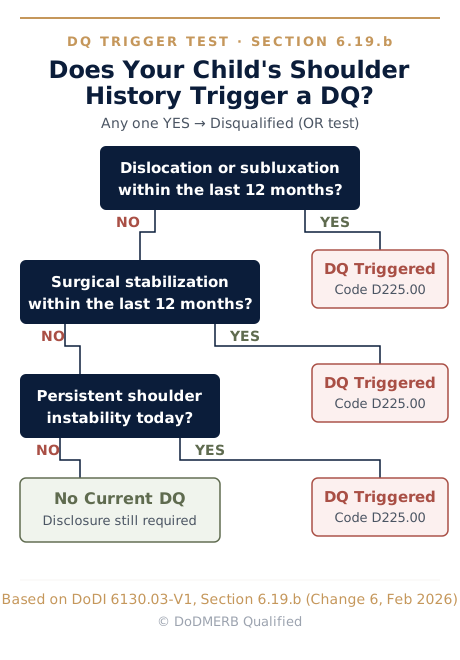
A shoulder event anywhere in the history triggers code D225.00. The decision that matters happens at the next step.
Related: DoDMERB Disqualifications: The Complete Code List
The Three Shoulder Histories Behind Code D225.00
All three produce the same disqualification. They call for different waiver packets. Three data points shape the file: the date of the most recent dislocation or subluxation, whether there was stabilization surgery, and the current symptom picture.
History 1: A Single Event, Years Ago, Stable Since
One dislocation or subluxation, no surgery, nothing since. This is still a disqualification under Section 6.19.b, and it is also the strongest version of the file.
The strategy is to prove the silence. Records showing one event and no recurrence, a current exam with full range of motion and negative apprehension testing, and seasons of contact sport played since the injury. The reviewer is looking for a shoulder that has already been tested and held.
History 2: Stabilization Surgery in the Record
Surgery does not erase the instability history, so Section 6.19.b still applies. It also does not start a countdown that ends the disqualification.
What surgery does give you is documentation. A surgical file arrives with an operative report, a defined rehab course, and a discharge exam, so the reviewer can see what was repaired and how the shoulder performed afterward. Make sure physical therapy is finished and documented, and that unrestricted activity after your child's medical release is on the record too.
None of that is a reason to have surgery. Whether to operate is a clinical decision between your child and their surgeon, and it should never be timed or chosen to shape a DoDMERB file.
History 3: Instability That Is Still Present
This is the hardest file, and not because of any clock. A shoulder that is unstable today answers the reviewer's central question the wrong way.
Persistent instability is not vague. It means recurrent giving-way, apprehension on overhead motion, positive apprehension or relocation testing on exam, or imaging showing unhealed labral pathology that matches current symptoms. A packet built on a shoulder in that condition is asking the reviewer to accept risk with nothing to offset it.
The work here is clinical before it is administrative. Getting to a stable, asymptomatic shoulder is a conversation with an orthopedic surgeon about your child's shoulder, not a DoDMERB strategy. Once that shoulder is stable and documented, the file looks like History 1 or History 2.
| Shoulder history | Standard | DoDMERB code | Does time clear it? | Waiver focus |
|---|---|---|---|---|
| Single event, stable since | DoDI 6.19.b | D225.00 | No | Years of recurrence-free unrestricted activity |
| Stabilization surgery in the record | DoDI 6.19.b | D225.00 | No | Operative report, PT discharge, documented return to sport |
| Instability still present | DoDI 6.19.b | D225.00 | No | Reaching a documented stable baseline first |
Labral Tears, Bankart Lesions, and SLAP Tears: What These Findings Mean for Your Application
The terms in your child's MRI report, including Bankart, SLAP, Hill-Sachs, and labrum, are not separate disqualifications. They are anatomical findings. What drives the DoDMERB code is the dislocation, subluxation, or instability sitting in the history, and that is Section 6.19.b.
The labrum deepens the socket and contributes to stability. When a shoulder dislocates anteriorly, the labrum is commonly torn.
Bankart Lesion (Anteroinferior Labral Tear)
A Bankart lesion is the anteroinferior labral tear that follows an anterior shoulder dislocation. Bankart lesions are common after that injury pattern.
A Bankart repair is a stabilization procedure. The file still runs through Section 6.19.b, on the history of dislocation and instability that made the repair necessary. It is not cartilage surgery. Section 6.19.q covers a different operation on different tissue: "History of cartilage surgery, including, but not limited to, cartilage debridement or chondroplasty for Grade II or greater chondromalacia, microfracture, or cartilage transplant procedure."
A Bankart repair is usually arthroscopic, and rehabilitation runs for months afterward. What belongs in the file is the operative report, the rehabilitation record, and documented unrestricted activity once the surgeon has released your child.
SLAP Tears
SLAP stands for Superior Labrum Anterior to Posterior. These tears involve the top of the labrum and the biceps tendon anchor, not the area damaged by a typical anterior dislocation. They come from acute traction or repetitive overhead loading: pull-ups, weighted lifting, throwing, rappelling.
SLAP tears turn up more often in military populations than in the general population. Many are managed nonoperatively first.
A SLAP tear with no dislocation, subluxation, or instability anywhere in the history does not meet Section 6.19.b on its face. What a DoDMERB physician codes in that situation depends on what the record shows. Current shoulder symptoms can bring Section 6.17.c into the picture, but that paragraph reaches symptoms that may reasonably be expected to prevent satisfactory performance of duty, not every ache in the chart. If your child has a SLAP repair and no instability history, ask which paragraph is being applied rather than assuming.
Hill-Sachs Lesion
A Hill-Sachs lesion is an impaction fracture on the back of the humeral head, caused by the head striking the front rim of the socket during dislocation. It is almost always present after an anterior dislocation and is not independently disqualifying. Listing it on the MRI does not add a new DQ code.
The next section covers AC separation, which runs on a completely different rule.
AC Joint Separation Has a Different Standard
An AC joint separation is not a shoulder dislocation, and it does not run on Section 6.19.b. Parents often see "shoulder" on an old urgent-care record and assume the dislocation rule applies. It does not.
AC separations involve the acromioclavicular joint between the collarbone and the shoulder blade, not the glenohumeral ball-and-socket. Different DoDI paragraph (6.19.c), different DQ code (D225.71), and a standard built on recency and symptoms instead of history.
Section 6.19.c Standard
Acromioclavicular separation within the last 12 months or if symptomatic.
— DoDI 6130.03, Section 6.19.c
Two triggers. The separation happened within the last 12 months, or the shoulder is symptomatic. Either one is enough on its own.
An AC separation from three years ago that has been pain-free since does not meet either trigger on the text of the standard. One that still aches under a rucksack meets the second trigger no matter how old the injury is, because "symptomatic" carries no expiration date.
The Rockwood Scale
Grade I is a sprain only, no displacement. Grade II is a partial ligament tear with slight displacement. Grade III is a complete tear with visible displacement. Grades IV through VI involve severe displacement and almost always require surgery. Most AC separations in high school athletes are Grade I or Grade II.
The grade does not appear in Section 6.19.c. It still belongs in the packet, because it tells the reviewer how severe the injury was and how much hardware or deformity to expect, and because higher grades are more likely to leave lasting symptoms. Grade matters through the symptom trigger, not through a cutoff.
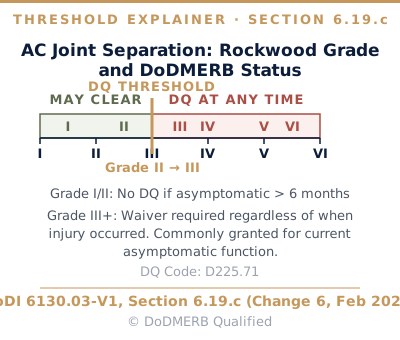
Section 6.19.c turns on recency and current symptoms. Rockwood grade is clinical context, not the trigger.
Parents who see "Grade I AC sprain" on a years-old urgent-care record can usually breathe. A separation that still hurts is a different conversation, and it deserves a current orthopedic evaluation well before the exam.
Building the Waiver Case: What Reviewers Actually Want to See
Waiver authorities are not asking "did this candidate ever have a shoulder problem?" They already know the answer, because that is why the file is on their desk. What they are weighing is future risk.
A reviewer is a military physician evaluating whether the candidate can serve and deploy without the shoulder becoming the limiting factor. The four risk areas below are our editorial framework for organizing a packet, not a published DoDMERB checklist. They are useful because a packet that speaks to all four leaves fewer open questions.
Four Risk Areas a Shoulder Packet Can Address
- Deployment risk: could this shoulder fail in an austere environment without orthopedic care available?
- Recurrence risk: given the candidate's age, anatomy, and treatment history, how likely is another dislocation?
- Monitoring requirements: does this candidate need ongoing physical therapy, imaging, or activity restrictions?
- Sudden incapacitation risk: could a shoulder failure compromise the candidate or unit during a critical task?
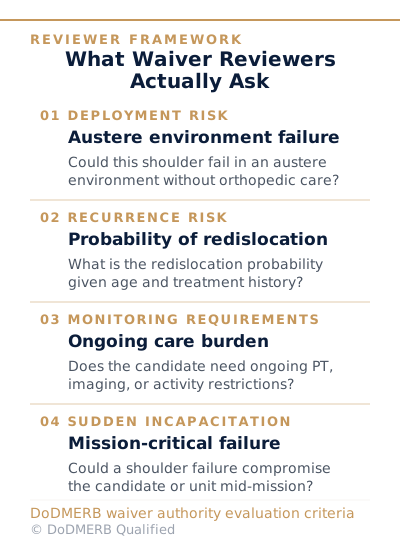
An editorial framework, not official criteria. Every document in the packet can be aimed at one of these four risk areas.
What a Physician Letter Can Usefully Cover
A clearance letter carries more weight when it answers the questions a reviewer would otherwise have to guess at.
- What the original injury was, and how it was treated.
- Current functional status, including range of motion, strength symmetry, and apprehension testing.
- The physician's assessment of recurrence risk given your child's anatomy and activity profile.
- Whether your child is currently asymptomatic during full unrestricted activity.
- Current functional ability during activities such as running, lifting, and pull-ups, with any restrictions documented explicitly.
Documentation Playbook
For the surgical path: operative report, post-op imaging, physical therapy discharge summary, a current orthopedic clearance letter, and evidence of unrestricted competitive activity since medical release.
For the nonsurgical path: original injury record, every subsequent encounter note, a current orthopedic clearance letter, and the same activity evidence. Both paths benefit from game logs, a coach letter, and CFA results when available.
Surgical Path
- Operative report (name of procedure, structures repaired, date)
- Pre- and post-operative imaging reports
- Physical therapy discharge summary (confirm full ROM, strength symmetry)
- Recent orthopedic clearance letter covering the five points above
- Evidence of unrestricted activity since medical release
Nonsurgical Path
- Original injury encounter note (date, mechanism, initial diagnosis)
- All subsequent orthopedic encounter notes (complete history, not just the most recent)
- Recent orthopedic clearance letter covering the five points above
- Evidence of unrestricted activity
Supporting Evidence (Both Paths)
- Coach letter or team roster confirming contact-sport participation
- CFA results or athletic performance data if available
- Physical therapy records if PT occurred (especially the discharge summary)
A packet built this way gives the waiver authority what it needs to weigh the shoulder as it is today.
DoDMERB Qualified
Not sure how to frame your child's shoulder file for the waiver authority?
We review your student's specific shoulder history against the four risk areas above and help you build a documentation packet that answers the right questions.
After Treatment: What Belongs in the Record
The DoDMERB exam usually lands in the late fall or winter of senior year, but the exam is not a deadline for evidence. The exam captures the shoulder as it is on that day. If a program later asks for more, records gathered after the exam can still go into the file through your DoDMERB case manager.
Surgery does not clear the disqualification, and neither does any timing strategy. Whether to operate is a clinical decision between your child and their orthopedic surgeon, made on medical grounds. Do not schedule, accelerate, or postpone an operation to produce a better application. There is no DoDI paragraph that rewards it, and the person absorbing the risk is your child.
If a Surgeon Independently Recommends Stabilization
If stabilization is recommended for clinical reasons and your child has it, the documentation follows the medicine rather than the calendar. After medical release, three things belong in the record:
- Completed rehabilitation, with a physical therapy discharge summary showing full range of motion and strength symmetry.
- Current stability, documented on a recent orthopedic exam, including apprehension and relocation testing.
- Unrestricted activity since release, documented over whatever period your child has actually accumulated.
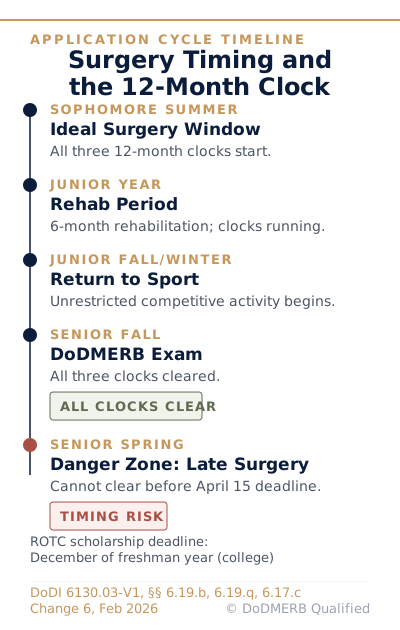
Treatment decisions are clinical. Documentation is what the file can control.
A Shoulder Still Recovering at the Exam
If your child is still in recovery when the exam happens, the reviewer sees a shoulder that is still healing, and the file will be thinner on the three items above. That is a description of the record, not a verdict, and it is not a reason to change a treatment plan. Send what exists, and add to it if the program requests more.
Medical timelines also differ by program. ROTC medical qualification does not run on the same calendar as a service academy application, and it varies between and within programs. Confirm the deadline that applies to your child's specific program instead of assuming a date.
Branch Variation
Each service and program waiver authority decides independently, so a denial at one commissioning source does not predict the outcome at another. Which office reviews the file, and whether waiver consideration is initiated at all, depends on the program. Apply broadly and confirm the route for each one.
The calendar does not clear the disqualification. What it can do is let real recovery be documented, so the waiver authority is looking at evidence instead of assurances.
Related: The DoDMERB Waiver Process from Start to Finish
The Bottom Line on Shoulder Dislocation and DoDMERB
The DoDMERB shoulder DQ is a yellow light, not a red one. Shoulder instability is commonly waiverable when the record shows current stability, unrestricted function, and acceptable recurrence risk, and the path follows a predictable structure.
Section 6.19.b is a history-of rule, so expect the disqualification. Plan for the waiver instead of hoping to dodge the code. The path depends on the shoulder history, what the imaging shows, and how much documented, stable, unrestricted activity your child has on the record.
What to Do This Week
- Pull every shoulder-related medical record you can get, regardless of how old it is, including ER notes, imaging, orthopedic consults, and PT discharge summaries. Section 6.19.b is a history-of standard, so a record from middle school is still relevant. Organize them at home in case a Remedial request arrives. Do not submit unsolicited.
- Write down every dislocation, subluxation, and surgery date in order. Reviewers read the pattern, and one event with nothing after it is a very different file from three events in two years.
- Match the file to one of the three shoulder histories above and note which documents are missing.
- Schedule an orthopedic clearance evaluation with a provider who can speak to the five points above.
A shoulder DQ does not end an officer track. Expect the disqualification, build the file deliberately, and route it through the DoDMERB case manager so the right documents reach the right reviewer. Strong documentation does not win the waiver by itself, and a denial is not a verdict on how well a family organized the record. The decision belongs to the waiver authority.
Frequently Asked Questions
Can my child get a DoDMERB waiver for a shoulder dislocation?
Often, yes. Shoulder instability is commonly waiverable when the record shows current stability, unrestricted function, and acceptable recurrence risk. The commissioning program decides whether to initiate waiver consideration, and the service or program waiver authority decides the outcome, weighing recurrence risk, current stability, and deployment readiness. The past injury is why the file exists; the current shoulder is what decides it. See the waiver case section above for documentation.
My son had one shoulder subluxation two years ago and no surgery. Will DoDMERB disqualify him?
Yes, expect the disqualification. DoDI 6130.03 Section 6.19.b covers any history of shoulder dislocation, subluxation, or instability, with no time limit, so a two-year-old event still meets the standard. That is not the disaster it sounds like. One event, no recurrence, a stable exam, and two years of unrestricted sport is one of the strongest waiver files there is.
Does shoulder surgery automatically disqualify my child from a service academy?
The instability that led to the surgery is disqualifying under Section 6.19.b, and that does not expire. Surgery neither removes the disqualification nor starts a countdown that ends it. What it can do is hand the waiver authority a clear record: an operative report, a defined rehab course, and a documented return to full activity. That is a reason to document a surgery your child needed, not a reason to have one.
What is the difference between a labral tear and a Bankart lesion?
A Bankart lesion is a specific type of labral tear, the anteroinferior tear commonly seen after an anterior shoulder dislocation. All Bankart lesions are labral tears, but not all labral tears are Bankart lesions. SLAP tears are upper-labrum injuries caused by overhead loading, not dislocation.
Will a Grade III AC separation from 10th grade still disqualify my child?
Not on the text of the standard, if the separation is more than 12 months old and the shoulder is symptom-free. Section 6.19.c reaches an AC separation within the last 12 months, or one that is symptomatic, and both conditions have to be clear. Rockwood grade is not the trigger. A 10th-grade separation that is well past 12 months and has caused no symptoms since meets neither condition. If DoDMERB codes it as D225.71 anyway, a current orthopedic exam documenting full function and no symptoms is the response.
How long after shoulder surgery should we wait before the DoDMERB exam?
There is no waiting period that clears the disqualification, and there is no DoDI paragraph that sets a required interval after surgery. Treat it as a packet question rather than a clock question. What a waiver authority can see is completed rehabilitation, a current exam showing a stable shoulder, and unrestricted activity since medical release. Schedule the exam on the application's timeline, not around a surgical anniversary, and never move a surgery date to hit one.
My child was denied a waiver at USAFA but approved at USMA for the same shoulder file. Why?
Each service and program waiver authority makes an independent call on its own criteria, and the programs do not even initiate waiver consideration the same way. A denial from one commissioning source does not predict outcomes at the others. Apply broadly. See waiver authorities by branch and program for who reviews what.
Should we use an orthopedic surgeon or a family doctor for the clearance letter?
An orthopedic provider who has managed your child's shoulder is generally best placed to write it, because the documentation should describe stability, recurrence risk, current function, and any restrictions, rather than give an opinion on military fitness. If a program or a Remedial request specifies who must write the letter and how recent it must be, follow that request. Those requirements come from the program and can differ between them.