You tore your ACL on the field, and now you're wondering if you tore your shot at a service academy too.
ACL reconstruction triggers a 12-month disqualification window under DoDI 6130.03-V1 (Change 6, February 2026). But the calendar is only half the equation. Section 6.18.d(4) also disqualifies candidates who remain symptomatic, unstable, or show muscle atrophy, with no time limit.
ACL surgery is disqualifying but routinely waivable, if you know the two conditions DoDMERB applies and build the right documentation package.
Key Takeaways
- 12-month window. DoDI 6130.03-V1 Section 6.18.d(4) sets the ACL reconstruction window at 12 months post-op.
- Two conditions in one rule. Section 6.18.d(4) disqualifies on time AND on symptoms, evaluated independently.
- Passing 12 months doesn't auto-clear your student. Persistent symptoms, instability, or thigh/calf atrophy can still disqualify.
- Five documents build a waiver-ready package. Operative report, surgeon clearance, PT summary, return-to-sport clearance, and imaging.
- Retained hardware is NOT an automatic DQ. Only disqualifying under specific conditions.
Step 1: Know the Two DQ Conditions in Section 6.18.d(4)
DoDMERB evaluates two conditions within the same provision, and your student can be disqualified under either one or both.
"History of surgical reconstruction of knee ligaments within the last 12 months, or which is symptomatic or unstable or shows signs of thigh or calf atrophy." — DoDI 6130.03, Section 6.18.d(4)
The 12-Month Window
If surgery was less than 12 months before the physical, your student is disqualified on time alone. Recovery progress does not matter.
The Symptom Condition
No time limit applies. Your student could be 2 years post-op and still be disqualified if the examiner finds symptoms, instability, or signs of thigh or calf atrophy. Documentation proving symptom-free status matters as much as the calendar.
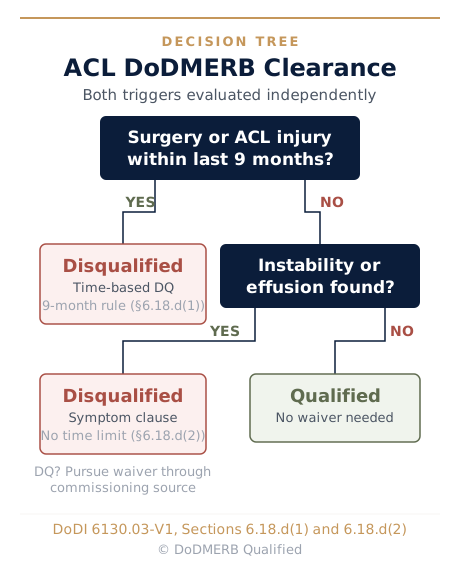
After this step, you know exactly which condition in Section 6.18.d(4) applies to your student's situation: time, symptoms, or both.
Related: Musculoskeletal DoDMERB Disqualifications: Complete Guide
Step 2: Time Your Surgery and DoDMERB Physical Strategically
The best ACL waiver is the one you never need, and that comes down to timing.
DoDMERB physicals typically happen in the fall of junior or senior year. Count backward 12 months from the likely physical date. If surgery falls inside that window, your student faces a time-based DQ regardless of recovery.
If Your Student Hasn't Had Surgery Yet
Schedule surgery early enough to be 12+ months post-op AND PT-discharged before the DoDMERB appointment. Academy applicants typically need medical qualification by approximately April 15 of the entry year. ROTC applicants have until roughly December of freshman year.
If Your Student Is Already Post-Op
Calculate the 12-month mark from the surgery date. If the physical is scheduled before that date, prepare for the waiver path in Steps 3 and 4. Do not reschedule without coordinating with your student's academy liaison officer.
After this step, you have a concrete timeline and know whether your student is on the direct-qualification path or the waiver path.
Step 3: Build Your Documentation Package Before the Physical
The difference between a 3-week waiver and a 3-month waiver is usually documentation, not the knee.
Do not submit these documents proactively or bring them to the physical. Keep them organized so your student can upload through DMACS 2.0 immediately if a Remedial is issued.
Documentation Checklist
- Operative report. Full surgical record detailing procedure, graft type, and hardware placed.
- Surgeon's clinical evaluation. Document diagnosis, treatment dates, recovery, instability, effusion, range of motion, strength, functional ability, and any restrictions.
- PT discharge summary. Quad strength at 90%+ of the uninvolved leg, single-leg hop test at 90%+ symmetry index.
- Return-to-sport clearance. Confirming full unrestricted athletic activity.
- Imaging reports. Post-op MRI or X-rays showing graft integrity and hardware position.
Retained screws are only disqualifying if symptomatic, if they interfere with wearing military equipment or uniforms, or if the fracture is not healed (Section 6.19.e(2)). Ask the surgeon to address hardware status in the clearance letter.
After this step, you have every document the waiver authority will request, before they ask for it.
Step 4: Navigate the Waiver Process — Who Decides and How Long It Takes
DoDMERB does not grant waivers. They forward your student's file to the commissioning source, which makes the decision.
Who Reviews Your Student's Waiver
| Commissioning Source | Waiver Authority |
|---|---|
| West Point | Command Surgeon |
| Army ROTC | Cadet Command Surgeon (Fort Knox) |
| USNA | BUMED |
| Navy ROTC | BUMED |
| USAFA | Academy Command Surgeon |
| Air Force ROTC | AFROTC Command Surgeon |
| USCGA | Academy Medical Review Board |
Realistic Timeline
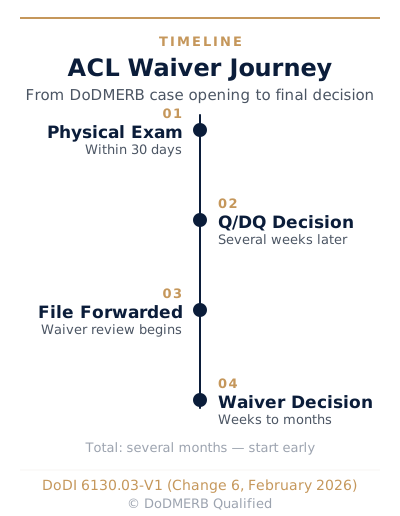
- Physical scheduling: Up to 30 days after DoDMERB opens the case.
- Initial Q/DQ decision: Several weeks after the physical.
- Waiver review: Weeks to months after the file is forwarded.
- Total: Several months from start to waiver decision. Start early.
Start early. Academy applicants need medical qualification by roughly April 15. ROTC applicants have until approximately December of freshman year.
DoDMERB Qualified
Not sure where your ACL case stands?
DoDMERB Qualified reviews ACL and orthopedic DQs.
After this step, you know who is reviewing the waiver, how long it takes, and what to expect at each stage.
Step 5: Handle Edge Cases — Hardware, Late Symptoms, and Re-Injury
Three edge cases trip up applicants who think they are in the clear.
Retained Hardware
Per Section 6.19.e(2), retained hardware is only disqualifying if symptomatic or if it may reasonably be expected to interfere with properly wearing military equipment or uniforms. Retained hardware is not disqualifying if fractures are healed, ligaments are stable, and there is no pain.
Late-Onset Symptoms
If symptoms, instability, or muscle atrophy develop after the 12-month mark, your student is disqualified under the symptom condition in Section 6.18.d(4). Do not skip rehab milestones to meet a calendar deadline.
Re-Injury
A re-tear resets the 12-month clock entirely. The documentation package must be rebuilt around the revision procedure. Note that recurrent ACL reconstruction is a separate disqualification under Section 6.18.d(5).
After this step, you have covered every ACL-related scenario DoDMERB can present.
Related: DoDMERB Waiver Process: Complete Guide
Frequently Asked Questions
Does ACL surgery automatically disqualify you from a service academy?
Yes, but it is routinely waivable. A disqualification means your student needs a waiver, not that they are rejected. Well-documented cases from qualified applicants have a meaningful chance of approval.
How long after ACL surgery can you pass DoDMERB?
Twelve months post-surgery per Section 6.18.d(4) of DoDI 6130.03. After 12 months, your student qualifies directly if symptom-free with no instability or muscle atrophy.
Do titanium screws from ACL surgery disqualify you?
No. Per Section 6.19.e(2), retained hardware is not disqualifying if fractures are healed, ligaments are stable, and there is no pain.
What documents do I need for an ACL waiver?
Five: operative report, current surgeon clinical evaluation documenting findings and restrictions, PT discharge summary (90%+ quad strength and hop symmetry), return-to-sport clearance, and post-op imaging.
Who grants DoDMERB waivers for ACL surgery?
DoDMERB does not grant waivers. Each commissioning source has its own authority: West Point uses the Cadet Command Surgeon, USNA uses BUMED. See What is DoDMERB?.
Can I get a waiver if my student still has knee instability?
Instability is disqualifying under Section 6.18.d(4) with no time limit. A waiver with documented instability is significantly harder to obtain. DoDMERB Qualified recommends completing rehabilitation fully first.
How long does an ACL waiver take?
Plan for several months from the initial physical to a final waiver decision. Having documentation ready when the Remedial arrives shortens the process significantly.
Should I delay my DoDMERB physical until after 12 months post-surgery?
Do not reschedule without consulting your student's academy liaison officer. If scheduled inside the 12-month window, prepare for the waiver path instead.
The appearance of U.S. Department of Defense (DoD) visual information does not imply or constitute DoD endorsement.