Your student was diagnosed with POTS, and DoDMERB just flagged it on their medical record. The post-COVID surge in POTS diagnoses has reshaped the DoDMERB landscape for 2025-2027 applicants. POTS incidence increased 16-fold after the pandemic, and approximately 31% of highly symptomatic long COVID patients develop the condition. Many of today's applicants contracted COVID during high school and received a POTS diagnosis as a result.
The military has drawn one of its hardest lines here. But that line has one narrow crack, and it hinges on a single question: was the diagnosis correct?
Key Takeaways
- DoDI 6130.03 Section 6.11.v disqualifies any history of POTS or IST with no exceptions
- "History of" means history of. Even resolved, asymptomatic POTS is disqualifying
- Waivers are virtually impossible for a confirmed, well-documented POTS diagnosis
- Misdiagnosis rates reach 69-80%, which is the one opening waiver reviewers may consider
- Inappropriate sinus tachycardia (IST) falls under the exact same regulation
What DoDI 6130.03 Actually Says About POTS
The regulation is one sentence. It leaves no room for interpretation.
The Verbatim Standard
"History of Postural Orthostatic Tachycardia Syndrome (POTS) or syndrome of inappropriate sinus tachycardia (IST)." — DoDI 6130.03, Section 6.11.v
In plain English: if your student has a documented POTS diagnosis at any point in their medical history, regardless of current status, Section 6.11.v applies. It does not matter whether symptoms have resolved. It does not matter whether your student feels perfectly healthy today.
There is no severity threshold. There is no exception pathway. There is no built-in mechanism to demonstrate that the condition has improved enough to warrant clearance.
The Cascade Effect
Even if Section 6.11.v did not exist, POTS symptoms independently trigger other disqualifying codes in the same chapter:
- Section 6.11.t: "History of recurrent syncope or presyncope, including black out, fainting, loss or alteration of level of consciousness (excludes single episode of vasovagal reaction with identified trigger such as venipuncture) unless it has not recurred during the last 24 months while off all medication for treatment of this condition."
- Section 6.11.u: Unexplained cardiopulmonary symptoms within the last 12 months
- Section 6.11.r: Resting heart rate over 100 bpm on three or more separate readings
These redundant codes mean that challenging 6.11.v alone is not sufficient if your student's symptoms have triggered additional flags. A comprehensive strategy must account for every code in the record.

After this section, you know the exact regulatory language that flagged your student's record and why it contains no built-in exceptions.
Why the Military Draws a Hard Line on POTS
POTS triggers in exactly the conditions military service demands every day.
The Trigger Profile
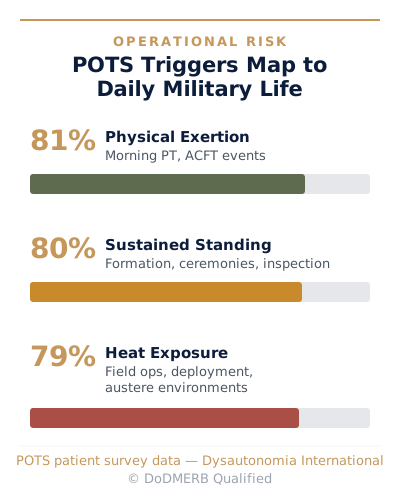
The three most common POTS aggravating factors map directly to unavoidable military activities: exertion triggers symptoms in 81% of patients, sustained standing in 80%, and heat exposure in 79%.
Morning PT, formation standing, field operations, and deployment in austere environments present all three triggers simultaneously. The military's baseline heat stroke rate of 31.7 per 100,000 person-years already represents a significant operational concern. POTS amplifies that baseline risk.
The Operational Risk
A service member with POTS who loses consciousness during formation, an ACFT event, or a combat operation creates both individual and unit-level risk. The statistics on functional capacity reinforce the concern: 60% of POTS patients cannot complete a structured exercise reconditioning program, and 25% are too debilitated to work or attend school.
The services have drawn a hard line because the operational environment presents exactly the triggers that POTS patients cannot reliably tolerate.
Why Waivers Do Not Work Here
Waiver authorities weigh condition stability against the demands of the specific duty. Unlike a healed fracture with clear imaging showing bone union, POTS has no definitive "resolved" state that medical reviewers can certify with confidence.
Symptom improvement does not equal physiological resolution. The underlying autonomic dysregulation can destabilize under physical stress, heat exposure, or sleep deprivation.
After this section, you understand why POTS is treated differently from most other cardiac conditions in the DoDMERB heart chapter.
Inappropriate Sinus Tachycardia: The Other Hard Line in Section 6.11.v
POTS gets the attention, but the same regulation disqualifies a second condition many families have never encountered.
What IST Is and How It Differs from POTS
Inappropriate sinus tachycardia is defined by a resting heart rate persistently above 100 bpm, or an average 24-hour heart rate above 90 bpm. The key difference from POTS: IST is not posture-dependent. The elevated heart rate persists at rest, not only upon standing.
Both conditions are dysautonomia-spectrum disorders. Both carry identical regulatory weight under Section 6.11.v.
| Condition | Trigger | Resting HR |
|---|---|---|
| POTS | Positional (standing) | Normal |
| IST | Constant (rest + exertion) | Elevated |
The Enforcement Record
An Air Force member with 8 years and 7 months of active service was found unfit for duty due to IST. She was separated with 10% disability. The VA subsequently rated the same condition at 80% disability.
This AFBCMR case demonstrates that IST causes operational incompatibility even in experienced, conditioned personnel. If the Air Force separates a serving member after 8 years over IST, the likelihood of a waiver for an incoming applicant is negligible.
After this section, you understand that IST carries identical disqualifying weight to POTS under the same regulation.
The One Narrow Opening: Was the POTS Diagnosis Correct?
There is one path forward, and it does not require changing the regulation. It requires questioning whether the diagnosis that triggered the regulation was correct.
A waiver reviewer may scrutinize whether the POTS diagnosis was made correctly. The data suggests that scrutiny is warranted more often than families expect.
The Misdiagnosis Epidemic
Sixty-nine percent of POTS patients are initially misdiagnosed with anxiety disorder. Eighty percent were told their symptoms were psychological before receiving a correct diagnosis. The average time to correct diagnosis: 4 to 6 years across 7 providers.
POTS received its own dedicated ICD code only in October 2022. Records from before that date may carry inconsistent coding, meaning many students have "POTS" documented without ever meeting the formal diagnostic criteria.
What a Confirmed POTS Diagnosis Actually Requires
Formal criteria: sustained heart rate increase of 30 bpm or more (adults) or 40 bpm or more (ages 12-19) within 10 minutes of standing, without a blood pressure drop exceeding 20 mmHg systolic, with symptoms present for more than 3 months. Both must be documented.
If a tilt table test or active stand test was never performed, the original diagnosis may not withstand expert review.
Conditions That Mimic POTS
Common mimics: anxiety disorder, vasovagal syncope, deconditioning, orthostatic hypotension, iron deficiency anemia, hyperthyroidism, IST, and pheochromocytoma.
Several of these — deconditioning, iron deficiency anemia, hyperthyroidism — are either not disqualifying or correctable. Deconditioning resolves with training. A single vasovagal episode with a clear trigger is explicitly excluded from the syncope disqualification. Note that orthostatic hypotension is not a safe alternative label: a documented orthostatic-hypotension diagnosis is itself treated as a disqualifying autonomic history. If the original diagnosis was genuinely one of the benign mimics, Section 6.11.v may not apply to your student at all.
Waiver reviewers evaluate diagnostic evidence, not just the label in the chart. A symptom-only diagnosis without formal autonomic testing is far more vulnerable to challenge. But revising a diagnosis already in the chart of record takes a written statement from the appropriate specialist (typically a neurologist) that gives the correct diagnosis, states whether POTS was formally ruled out, and explains the basis for the revision. A verbal claim that "it wasn't really POTS" is not enough — the chart of record controls until a specialist revises it in writing.
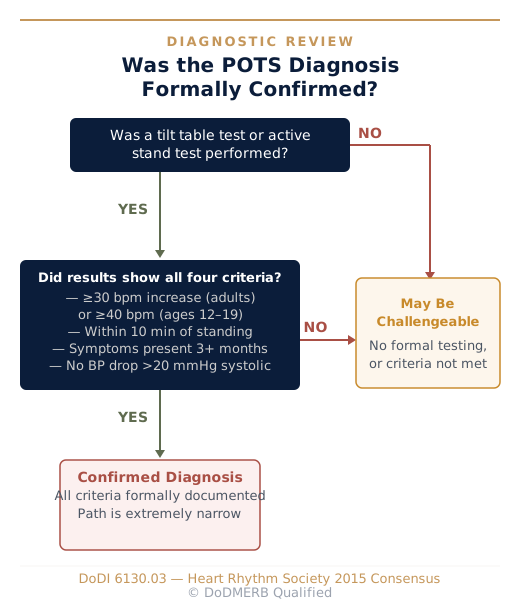
All four criteria must be documented for a POTS diagnosis to survive expert review. Missing any one creates an opening.
After this section, you understand the one viable path forward and can begin evaluating whether it applies to your student's specific records.
DoDMERB Qualified
Not sure whether your student's POTS diagnosis meets the formal criteria DoDMERB applies?
We review your student's full medical record against DoDI 6130.03 standards, identify whether the original diagnosis is defensible, and build a clear plan for the waiver review process.
What "History Of" Really Means for POTS Applicants
Some families discover too late that their student does not need active POTS symptoms to be disqualified for POTS.
The "History Of" Trap
The regulation says "history of POTS," not "current POTS diagnosis." A POTS diagnosis at age 14, fully resolved by age 17, still disqualifies at age 18 under the current DoDI language.
Some websites claim that mild or resolved POTS may receive waivers. This is inconsistent with how Section 6.11.v is applied. The regulation contains no severity qualifier and no resolution bypass.
The Developmental Subtype Question
Some adolescents develop POTS-like symptoms during puberty that genuinely improve or resolve over time. But the DoDI does not distinguish between persistent POTS and developmental-onset POTS that resolved. "History of" captures both.
This is where the misdiagnosis argument becomes essential. If the original episode was actually deconditioning or a vasovagal pattern that resolved with maturation, it may not constitute a "history of POTS" at all. The argument is not that the condition resolved. The argument is that the original diagnosis was never correct.
After this section, you understand why current symptom status does not change the regulatory outcome, and what the only path through it actually requires.
What to Do Now After a POTS Disqualification
If the misdiagnosis argument has any chance of applying to your student, there is a specific sequence of steps that gives you the strongest position.
Gather Every Record Related to the Diagnosis
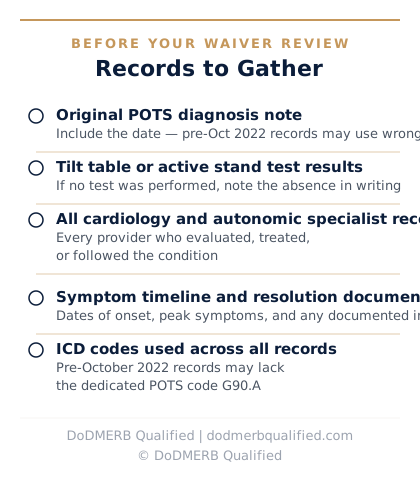
Collect every record where POTS, IST, or orthostatic tachycardia appears: initial evaluation, autonomic testing, cardiology notes, and treatment records.
Get an Expert Review of the Diagnostic Evidence
This is not a second opinion from another cardiologist. It is a structured review of whether the original diagnosis holds up under the standard DoDMERB medical reviewers apply.
At DoDMERB Qualified, our team reviews case files behind the scenes. Cases are managed by LTC Robert Kirkland.
Set Honest Expectations
If the original diagnosis was well-documented with formal autonomic testing meeting all criteria: the path is extremely narrow.
If the diagnosis was based on symptoms alone, without formal testing, or made during a COVID recovery period without a tilt table test: there is a real opening worth pursuing.
Do not withdraw the application. ROTC scholarship recipients have until approximately December of their freshman year to complete medical qualification. Academy applicants face an April 15 deadline. ROTC provides more runway for a complex case like this.
After this section, you have a concrete action plan and honest expectations about what the path forward requires.
The Bottom Line on POTS and DoDMERB
POTS is one of the hardest disqualifications in the DoDMERB heart chapter. The regulation leaves no room for resolved symptoms, improved test results, or good intentions.
Three realities define this situation:
- DoDI 6130.03 Section 6.11.v disqualifies any history of POTS or IST with no exceptions written into the regulation.
- Waivers for a confirmed, well-documented POTS diagnosis are virtually non-existent.
- The one viable path is demonstrating the original diagnosis was incorrect. Given that misdiagnosis rates reach 69-80%, that path is more viable than most families realize.
The 16-fold post-COVID surge in POTS diagnoses means more applicants are facing this disqualification than at any point in DoDMERB history, and many of those diagnoses were made without formal autonomic testing.
If you want your student's medical record reviewed, contact LTC Robert Kirkland at DoDMERB Qualified.
Frequently Asked Questions
Can my student get a POTS waiver if their symptoms have resolved?
No. Section 6.11.v uses "history of POTS," making current symptom status irrelevant. The only path is demonstrating the original diagnosis was incorrect.
Does dysautonomia automatically disqualify from DoDMERB?
Not necessarily. POTS and IST are specifically named in Section 6.11.v. Other dysautonomia subtypes fall under different sections with different outcomes.
My student was diagnosed with POTS after COVID. Is that treated differently?
No regulatory exception exists for post-COVID POTS. However, post-COVID diagnoses are more likely to lack formal autonomic testing, which may support a misdiagnosis argument.
What is the difference between POTS and IST for DoDMERB purposes?
None. Both are disqualified under Section 6.11.v identically. POTS causes a positional heart rate spike; IST causes a persistently elevated resting heart rate.
Could my student's POTS actually be something else?
Possibly. Sixty-nine percent of POTS patients are initially misdiagnosed, most often with anxiety. If formal autonomic testing criteria were never met, the diagnosis may be challengeable.