Your teenager has Crohn's disease or ulcerative colitis, and they want a service academy or an ROTC scholarship. You are trying to figure out whether to keep going or redirect the dream.
The honest answer changed on May 6, 2026, when the U.S. Military Entrance Processing Command (MEPCOM) added inflammatory bowel disease to its "Conditions Unlikely to be Waived" list. The officer-track regulatory anchor has not changed: DoDI 6130.03-V1, Change 6, Section 6.12.c(1), DQ code D161.40, still names Crohn's and UC by name.
A Crohn's or UC diagnosis is a disqualification, and a waiver is rare. Your student's medication history, remission documentation, and pathway choice still change the math. DoDMERB applies to officer commissioning paths: service academies, ROTC scholarships, and the Coast Guard Academy.
Key Takeaways
- IBD triggers DQ code D161.40 under DoDI 6130.03 Section 6.12.c(1), and "history of" means any past confirmed diagnosis on a medical record, regardless of current symptoms or medication status.
- Medication history stacks DQ codes. Mesalamine monotherapy keeps the file at one code. Systemic steroids, biologics, and immunosuppressants add a second or third code under Sections 6.30.j and 6.30.l.
- Clinical remission is not enough. Waiver boards expect endoscopic mucosal healing confirmed by a colonoscopy within 12 months, with pathology biopsies.
- One IBD waiver granted in five years is the historical data point reported by a former DoDMERB staff member. Plan accordingly.
- Apply to multiple pathways. Each has a different waiver authority, and each evaluation is independent.
What DoDI 6130.03 Actually Says About IBD
The DQ is not a judgment call by an examiner. It is a single sentence in DoDI 6130.03 that names Crohn's disease by name.
The IBD disqualification
"History of inflammatory bowel disease, including, but not limited to, Crohn's disease, ulcerative colitis, ulcerative proctitis, or indeterminate colitis." — DoDI 6130.03, Section 6.12.c(1)
In plain English: this is DQ code D161.40. Note the phrase "history of." Any confirmed diagnosis, regardless of current status, triggers the code. Students with ulcerative proctitis, the mildest form limited to the rectum, are often surprised to find themselves disqualified. They are.
The ostomy disqualification
"The presence of any ostomy (gastrointestinal or urinary)." — DoDI 6130.03, Section 6.12.g(3)
In plain English: this is DQ code D164.41, and it stacks independently on top of D161.40. A student who underwent colectomy or ileostomy for UC carries two independent DQ codes, even if the ostomy is fully functional and the IBD is controlled.
Medication DQs, preview
DoDI 6130.03 Sections 6.30.j and 6.30.l create additional, stacking DQ codes based on the medications a student has been prescribed during treatment. Section 6.30.j covers systemic immunosuppressants (azathioprine, 6-MP, methotrexate). Section 6.30.l covers refrigeration-dependent or injectable agents (Humira, Remicade, Entyvio, Stelara, Skyrizi). These codes are separate from the diagnosis itself and are reviewed independently. The next section breaks the medication tiers down by drug class.
Related: For a complete breakdown of all DoDI 6130.03 medical standards, see the DoDI 6130.03 Medical Standards Guide.
After this section, you can name the exact regulatory paragraph and DQ code(s) on your student's file.
Why the Military Treats IBD as an Operational Risk
The military's concern is not whether your student is healthy today. It is whether your student can stay healthy in conditions specifically designed to trigger IBD flares.
The waiver authority is asking whether the student will be deployable for the next 20 years in environments that include sustained psychological stress, sleep deprivation, field-ration nutrition, and limited GI medical access.
The stress-flare data
A prospective case-crossover study of 50 IBD patients in remission found that a high-stress event increased the odds of an IBD flare the next day by a factor of 7.33 for Crohn's disease, and 4.8 for IBD overall. Military training and deployment environments produce exactly these stressors on a sustained basis. A student who is asymptomatic in a suburban GI clinic is a statistically different organism under six months of plebe year, Beast Barracks, or a forward deployment rotation.
Deployment logistics for biologics
A service member on Humira, Remicade, Entyvio, Stelara, or Skyrizi requires refrigeration at 36-46°F and either subcutaneous injection or IV infusion on a fixed schedule. There is no cold chain on a forward operating base, no medical refrigerator on a submarine for a 90-day patrol, and no infusion suite in a field environment. This is the operational reason DoDI 6130.03 Section 6.30.l exists as a separate disqualifying criterion for injectable and refrigeration-dependent medications.
Why remission isn't enough
Even endoscopic remission does not resolve the core military concern. A relapse mid-deployment means medevac, mission impact, and a service member who cannot carry their share of the load. The waiver authority is assessing whether the student's downside risk is meaningfully higher than that of an otherwise identical candidate without an IBD diagnosis on record. That risk differential, not present-day health, is what a waiver packet has to overcome.
After this section, you can explain to a GI specialist or recommender why the military cares about IBD even when remission is solid.
How Your Medication History Multiplies Your DQ Codes
Two students can both have Crohn's. One carries one DQ code on their DoDMERB file. The other carries three. The difference is which prescriptions they walked out of the GI office with.
DoDI 6130.03 does not just disqualify on the diagnosis. Sections 6.30.j and 6.30.l each independently stack a DQ for the medication itself. Reviewers count codes. More codes equals lower waiver odds, every time.
The four medication tiers
The table below maps the most common IBD medication histories to the DQ code count they trigger on a DoDMERB file.
| Tier | Medication History | DQ Codes Triggered | Waiver Profile |
|---|---|---|---|
| 1 | No medication, ever | D161.40 only | Cleanest possible file |
| 2 | Mesalamine/5-ASA only (Asacol, Lialda, Pentasa, Apriso, Delzicol) | D161.40 only | Clean file. Mesalamine is NOT an immunosuppressant |
| 3 | Systemic steroids (prednisone, budesonide) more than 2 months at any point | D161.40 + D200.29 | Two codes |
| 4 | Biologics or immunosuppressants ever: Humira, Remicade, Entyvio, Stelara, Skyrizi, Xeljanz, azathioprine, 6-MP, methotrexate | D161.40 + D200.29 + possibly 6.30.l | Two or three codes; lowest waiver odds |
The mesalamine distinction parents miss
Mesalamine (5-aminosalicylic acid) acts topically on the gut lining and does not suppress systemic immunity. DoDI 6130.03 Section 6.30.j targets "systemic immunosuppressant medications." Mesalamine does not meet that definition. A student on mesalamine monotherapy from diagnosis to today carries exactly one DQ code (D161.40), not two.
The GI specialist letter should state explicitly: "Patient has never been on systemic corticosteroids beyond [X weeks] or any immunosuppressant or biologic agent." That single sentence keeps the file at one code.
Prior biologic use doesn't disappear
DoDMERB reviews lifetime medication history, not current prescriptions. A student who took Humira at age 14, stopped at 16, and is now mesalamine-only at 18 still carries DQ code D200.29 for the prior biologic use. The medication record does not reset when the prescription ends. Medication choices made early in the disease course have DoDMERB consequences a decade later.
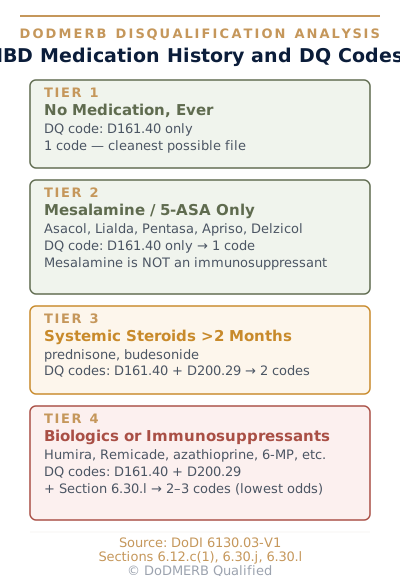
Medication history determines DQ code count. Tiers 1 and 2 carry the same single code — the mesalamine distinction matters.
After this section, you can identify which tier your student falls into and how many DQ codes their file currently carries.
What "Remission" Actually Means to DoDMERB
When your GI doctor says your student is in remission, they usually mean symptoms are quiet. When a waiver board says remission, they mean a colonoscopy with biopsies showed healed mucosa.
This gap is responsible for a meaningful share of denied IBD waiver packets. Families submit symptom logs, CRP numbers, and "patient is doing well" letters, and assume they have met the bar. They have not.
Clinical vs. endoscopic remission
Clinical or symptomatic remission means no diarrhea, no abdominal pain, no urgency, no fatigue. Endoscopic remission means direct visualization of the colon and, for Crohn's, the terminal ileum, showing healed mucosa, confirmed by biopsy pathology finding no active inflammation. Without endoscopic documentation, a waiver request for IBD faces a high likelihood of denial, regardless of how healthy the student appears in clinic.
The biomarker package waiver reviewers expect
A packet that will receive serious consideration includes objective lab data alongside the colonoscopy: C-reactive protein (CRP), erythrocyte sedimentation rate (ESR), fecal calprotectin (ideally below 50 µg/g), albumin, and a complete blood count (CBC) with no anemia. These are not additions that strengthen a weak packet. They are baseline expectations. A missing fecal calprotectin is a tell that the family assembled the packet themselves without specialist guidance.
How recent does the colonoscopy need to be
Standard expectation is within 12 months of the waiver submission. A colonoscopy performed at age 14 does not support a waiver application at 18. Schedule the GI workup before the application timeline begins, not after the waiver request is in motion.
After this section, you can tell your GI specialist exactly what the waiver board needs, not what routine monitoring would order.
Waiver Odds by Pathway: Service Academy vs. ROTC vs. Enlisted
Whether your student gets a waiver is not decided by DoDMERB. It is decided by a different surgeon's office for every pathway your student applies to, and applying to more than one is the rational strategy.
DoDMERB performs the medical exam and assigns DQ codes. The decision to waive sits with the receiving program's surgeon.
The enlisted pathway and the May 2026 update
As of May 6, 2026, MEPCOM officially designated IBD a "Condition Unlikely to be Waived" for enlisted accessions. Officer-track pathways follow DoDI 6130.03 under per-service waiver authorities, not MEPCOM pre-screening. The underlying institutional skepticism is the same.
The 1-in-5-years data
A former DoDMERB staff member with five years at the agency reported observing one IBD waiver granted in that period across all officer-commissioning pathways. This is the most specific publicly available data point on IBD entry-level waivers.
"In five years at DoDMERB, I saw one IBD waiver granted." — Former DoDMERB staff member
Waiver authority by pathway
Each commissioning pathway has an independent waiver authority.
| Pathway | Waiver Authority | Notes |
|---|---|---|
| Army ROTC | Cadet Command Surgeon, Fort Knox | Historically most flexible |
| Navy/Marine ROTC | BUMED | Strict; aviation = no waiver |
| Air Force ROTC | AETC Surgeon General | IBD treated as CUW-equivalent |
| USMA (West Point) | Academy Medical Officer | Independent from ROTC review |
| USNA (Annapolis) | Academy MO/BUMED coordination | Same BUMED skepticism as NROTC |
| USAFA (Colorado Springs) | Academy Medical Officer | No aviation waiver per NAMI |
| USMMA (Kings Point) | DoDMERB determination | No independent waiver authority; DoDMERB outcome is effectively final |
| USCGA | Academy Medical Officer | Most selective overall |
The entry-vs-retention asymmetry
Military policy grants more latitude to service members who develop IBD after accession than to candidates who arrive with the diagnosis. An officer who develops UC on active duty enters a Medical Evaluation Board process that can result in retention. An applicant with the same diagnosis faces DQ code D161.40 and a waiver authority that granted one approval in five years.
Why multiple pathways matter
Every additional commissioning pathway is an independent waiver authority reviewing the same medical file. Adding Army ROTC to academy applications costs a few hours of paperwork and doubles the number of independent decisions in play. For IBD candidates, multi-pathway application is the baseline.
After this section, you know who decides your student's waiver, what the realistic approval rate looks like, and why a multi-pathway application is the rational move.
DoDMERB Qualified
IBD is one of the hardest DoDMERB categories. Get a case review before you submit.
We evaluate your student's specific medication history, remission documentation, and pathway options so you go into the waiver process with a strategy, not a guess.
The Documentation Package That Actually Moves a Waiver Board
A waiver board evaluating an IBD case sees dozens of packets. The ones that receive serious review look almost identical in structure.
Odds are low. Families who file incomplete or generic packets fail because their packet is, not because their case is hopeless.
The six-piece packet
Required Documentation
- Recent colonoscopy report (within 12 months) with pathology confirming endoscopic and histologic remission
- Full lab panel within 90 days: CRP, ESR, fecal calprotectin, albumin, CBC
- GI clinical evaluation documenting the diagnosis, treatment dates, current medication requirements, examination findings, endoscopic remission status, functional ability, and any restrictions. Actual clinical records carry more weight than a summary letter or opinion on military fitness; Air Force rebuttals do not accept physician letters, statements, or memos
- Candidate personal statement: diagnosis timeline, treatment history, current medication, athletic participation (sports, duration), symptom-free duration, motivation for service
- If mesalamine-only: explicit written statement from the GI that "Patient has never been on systemic corticosteroids beyond [X weeks] or any immunosuppressant or biologic agent." This keeps the file at one DQ code rather than two
- Performance references: coaches, supervisors, or teachers documenting performance under physical and mental stress. Not character references
What not to include
Pediatric primary care notes are not a waiver packet. A pediatrician letter is not a GI specialist letter. Symptom logs without biomarker data do not substitute for lab results. Volume does not substitute for the specific documents the waiver authority is trained to look for.
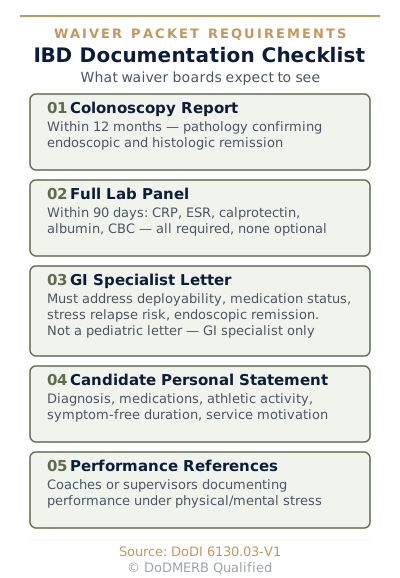
The five-document packet structure waiver boards expect. Missing any one item signals an unprepared family.
Related: For a complete walkthrough of the DoDMERB waiver submission process, see the DoDMERB Waiver Process Guide.
After this section, you have a packet outline you can hand to your GI specialist at the next appointment.
What to Do Right Now, by Scenario
Your next move is not the same as the family three rows over. Find your scenario and start there.
Three scenarios cover the most common IBD candidate presentations.
Scenario A — Medication-free, in remission
The cleanest possible file. First actions:
- Schedule a colonoscopy immediately if the last one is more than 12 months old.
- Pull labs (CRP, ESR, fecal calprotectin, albumin, CBC) within 90 days of expected DoDMERB scheduling.
- Begin the candidate personal statement now.
- Apply to multiple pathways. At minimum, one academy and Army ROTC.
Scenario B — Mesalamine monotherapy
The second-cleanest file. First actions:
- Same colonoscopy and lab workup as Scenario A.
- Request that the GI specialist include the mesalamine-only sentence explicitly. Do not assume they will include it without being asked.
- Document the duration of continuous mesalamine therapy. Longer uninterrupted treatment without biologic or immunosuppressant exposure strengthens the file.
- Apply to multiple pathways. Army ROTC's Cadet Command Surgeon is historically the most flexible.
Scenario C — Prior or current biologic or immunosuppressant use
The most complex profile. First actions:
- Discuss with the GI whether a medically appropriate step-down to mesalamine monotherapy is feasible. The decision is medical, but it changes the DQ code count.
- If currently on biologics, Section 6.30.l applies while the medication is active. A medically safe switch to a non-refrigerated alternative changes the file.
- Consider whether to apply this cycle or establish a documented period of mesalamine-only or medication-free remission first.
- Get a case review before filing. A generic packet is likely to fail.
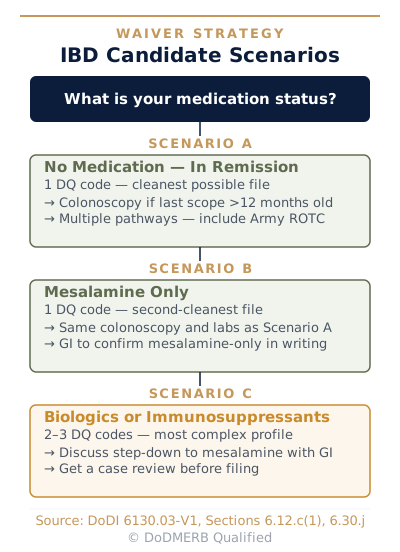
Three scenarios, three starting points. Identify yours and act before the next GI appointment.
When to stop and reconsider
If your student has a current ostomy (DQ D164.41), active fistulizing disease, or an IBD hospitalization within the last 24 months, defer this cycle. Re-evaluate in 12 to 24 months once a longer remission record exists.
After this section, you have a first action and a one-month checklist tied to your student's specific situation.
The Honest Verdict
IBD is one of the harder DoDMERB categories, and a waiver is rare. But rare is not zero, and the file your student builds determines which side of rare they land on.
- The diagnosis is a categorical disqualification. Your student's medication history determines how many DQ codes stack on top of it.
- "Remission" to a waiver board means endoscopic mucosal healing confirmed by colonoscopy within 12 months. Not "feels fine and labs are stable."
- Apply to multiple pathways. Each pathway has a different waiver authority, a different surgeon, and a different decision.
The May 2026 MEPCOM CUW designation reflects where policy stands today. The 1-in-5-years data is the floor for generic packets, not the ceiling for well-documented cases with specialist support. The packet quality you build now is the variable that remains in your control.
Frequently Asked Questions
Can a student outgrow Crohn's or UC for DoDMERB purposes?
No. DoDI 6130.03 Section 6.12.c(1) disqualifies on "history of" inflammatory bowel disease. A past confirmed diagnosis on a permanent medical record triggers DQ code D161.40 regardless of current health status or symptom duration.
Is microscopic colitis the same as ulcerative colitis under DoDI 6130.03?
No. Microscopic colitis is a separate diagnosis and is not listed in Section 6.12.c(1). Confirm the diagnostic code on your student's records. A childhood misclassification on a chart can shadow a candidate for years if not corrected.
My student has IBS, not IBD. Is that a DQ?
IBS is a functional GI disorder governed by different sections of DoDI 6130.03 and is not the same DQ as IBD. However, IBS does require documentation, particularly if there were ever rule-out workups for IBD.
Does mesalamine count as an immunosuppressant for DoDMERB?
No. Mesalamine acts topically on the gut lining and does not suppress systemic immunity. It does not trigger DoDI 6130.03 Section 6.30.j. A student on mesalamine monotherapy carries one DQ code (D161.40), not two.
My student was on Humira at 14 but is off all medication now. Does the history still count?
Yes. DoDMERB reviews lifetime medication history, not current prescriptions. Prior biologic use triggers DQ code D200.29 regardless of when the medication was stopped. The waiver packet must address this directly in the GI specialist letter.
Can a student get a waiver after a colectomy or ileostomy?
An ostomy is an independent disqualification under Section 6.12.g(3), DQ code D164.41. This stacks on top of the IBD DQ. For entry-level candidates, a history of ostomy surgery is one of the hardest waiver cases. Defer this cycle and monitor policy developments.
How does the May 2026 MEPCOM update affect officer-track pathways?
MEPCOM's "Conditions Unlikely to be Waived" list governs enlisted accession. Officer pathways follow DoDI 6130.03 under per-service waiver authorities and are not directly governed by MEPCOM pre-screening. The signal reflects the same institutional view of IBD.
Should we apply to a service academy, ROTC, or both?
Both. Each pathway has an independent waiver authority and represents a separate decision. Army ROTC's Cadet Command Surgeon at Fort Knox has historically shown the most flexibility across medical conditions. Multi-pathway application is the baseline strategy for IBD candidates.
How long does a DoDMERB waiver review take for an IBD case?
Standard DoDMERB processing runs 4-12 weeks. An IBD case that triggers remedial requests for additional documentation can extend to 6-9 months. Start the GI workup, colonoscopy and labs, at least 12 months before the application deadline.
The appearance of U.S. Department of Defense (DoD) visual information does not imply or constitute DoD endorsement.