Your student had an appendectomy, and now you are reading about DoDMERB disqualifications. DQ code D164.40, the code that covers appendectomy military service eligibility, is time-limited. It expires 3 months after surgery. This is not a permanent disqualification. It is a countdown.
A fully healed appendectomy answers "no" to all four waiver questions: progressive? No. Aggravated by service? No. Precludes training? No. Hazard to others? No. The appendix has no ongoing function once removed.
The appendectomy is not the problem. Timing and documentation are the only variables. This guide covers the exact regulation, recovery timelines, strategic exam scheduling, a documentation checklist, and the one rare complication that changes everything.
Key Takeaways
-
DQ code D164.40 expires 3 months after surgery. A healed appendectomy is not permanently disqualifying at any service academy or ROTC program.
-
Schedule the DoDMERB exam 3 months + 1 week after surgery to avoid triggering the DQ entirely.
-
Air Force officer candidate waiver approval rates have risen from 56% to 74% over two fiscal years, and a healed appendectomy is among the most favorable waiver categories in the system.
-
The same DQ code applies to uncomplicated and ruptured cases. The difference is documentation depth, not the regulatory standard.
-
In 0.2% to 1.8% of appendectomy cases, the underlying cause is Crohn's disease, which is permanently disqualifying. The pathology report is your safeguard.
The Three-Month Rule: What DoDI 6130.03 Actually Says
The entire appendectomy disqualification is one sentence in DoDI 6130.03. One sentence, one clock, one clear path forward. Here it is, verbatim from Section 6.12.g(2):
"History of open or laparoscopic abdominal surgery during the last 3 months."
That is the full standard. There is no qualifier about the type of abdominal surgery, the severity, or the outcome. Appendectomy, gallbladder removal, hernia repair, exploratory surgery. The same one-sentence rule governs all of them.
DQ code D164.40 is how DoDMERB translates this regulation into a determination. When a DoDMERB provider reviews your student's medical history and finds abdominal surgery within the preceding 3 months, D164.40 is the code that appears on the report. After 3 months with full recovery, that code no longer applies. There is no additional review, no secondary standard, no discretionary judgment. The clock expires and the DQ disappears.
There is no standalone permanent disqualification for a healed appendectomy. The Naval Academy's published gastrointestinal disqualifiers (Appendix A) list Crohn's disease, ulcerative colitis, GERD, and peptic ulcer disease. A healed appendectomy does not appear on that list. No service academy permanently disqualifies for it.
The four questions that waiver authorities evaluate reinforce this point. Is the condition progressive? No. The appendix is gone permanently. Will military service aggravate it? There is nothing left to aggravate. Does it preclude satisfactory completion of training? A healed surgical site does not interfere with any physical requirement. Does it constitute an undue hazard to the applicant or others? No. A fully healed appendectomy answers "no" to all four questions, making it one of the most favorable DQ categories in the waiver system.
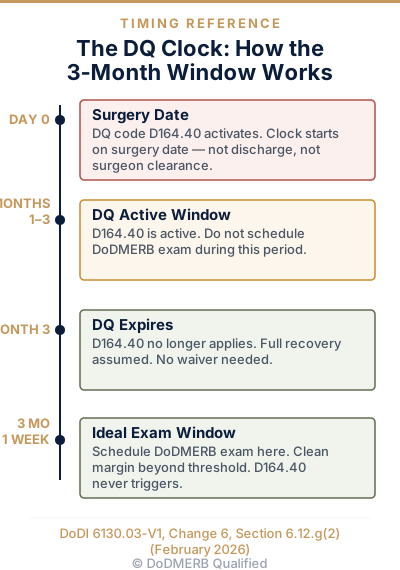
After this section, you know the exact regulation (Section 6.12.g(2)), the DQ code (D164.40), and that it expires at 3 months post-surgery.
Related: DoDMERB Remedial vs. Disqualification Explained
Uncomplicated vs. Ruptured Appendix: Two Different Recovery Paths
A routine laparoscopic appendectomy and a ruptured appendix with peritonitis are two different recovery experiences. Both resolve. But the documentation your student needs for DoDMERB differs significantly, and parents with ruptured cases need to plan accordingly.
For an uncomplicated laparoscopic appendectomy, the hospital stay is approximately 24 hours. Most patients recover fully in 1 to 2 weeks and return to normal activities, including contact sports and gym workouts, within 3 to 4 weeks after surgeon clearance. For high-school-age applicants specifically, pediatric surgical teams typically clear contact sports at 2 to 4 weeks and swimming at 1 to 2 weeks post-op. The 3-month DoDMERB window is conservative. Your student will likely be fully healed in half that time.
Open appendectomy (less common today) requires a longer recovery. Return to work or school takes 3 to 4 weeks, with full recovery at 4 to 6 weeks. Still well within the 3-month window.
A ruptured or perforated appendix is a different situation entirely. The appendix can rupture within 36 hours of first symptoms, turning a routine surgery into a complex recovery. Hospital stays average 5 days, often with a 5-day IV antibiotic course. Full recovery takes 6 or more weeks. Postoperative abscesses occur in 3% to 20% of ruptured cases, and rupture increases infection risk from 3% to 15%. A CT scan may be required to check for abscess, and drainage under anesthesia may follow. These complications all resolve, but each one needs documented resolution before DoDMERB will consider the case closed.
Here is how the three scenarios compare:
| Uncomplicated Laparoscopic | Open Appendectomy | Ruptured/Perforated | |
|---|---|---|---|
| Hospital Stay | ~24 hours | 2-3 days | 5+ days |
| Physical Recovery | 1-2 weeks | 3-4 weeks | 6+ weeks |
| Full Activity Clearance | 3-4 weeks | 4-6 weeks | 8+ weeks |
| DoDMERB Documentation | Standard (4 documents) | Standard (4 documents) | Extended (8+ documents) |
Regardless of complication level, the DQ code is the same: D164.40. The 3-month rule still applies. The difference is not the regulatory standard. It is the depth of documentation DoDMERB will expect when reviewing your student's case.
Complications DoDMERB may ask about in ruptured cases include abscess formation, peritonitis, bowel obstruction, and secondary infection. Each needs a documented resolution from the treating physician.
After this section, you know which recovery path applies to your student and what documentation that path requires.
Strategic Timing: When to Schedule the DoDMERB Exam
The single best strategy for an appendectomy case is scheduling the DoDMERB exam after the 3-month window has closed. If you time it right, DQ code D164.40 never triggers. It never appears on your student's record. The appendectomy becomes a line item on the medical history form, not a disqualification.
The ideal scheduling window is 3 months plus 1 week from the date of surgery. This provides a clean margin beyond the regulatory threshold and ensures your student's surgeon has had time to issue a formal clearance for unrestricted physical activity.
For Academy applicants, work backwards from the April 15 medical qualification deadline. DoDMERB exam processing takes approximately 1 month. Factor in another 2 to 4 weeks for any remedial requests. That means the exam should be completed by early to mid February at the latest.
Here is how surgery timing maps to deadline risk:
| Surgery Month | 3-Month Window Closes | Schedule Exam By | Academy Deadline Risk | ROTC Deadline Risk |
|---|---|---|---|---|
| August | November | December | None | None |
| October | January | Late January | None | None |
| December | March | Early March | Low | None |
| January | April | Cannot avoid DQ | High (triggers D164.40) | None |
| February | May | Cannot avoid DQ | High (waiver required) | None |
An August or October surgery is the cleanest Academy scenario. The 3-month window closes well before the spring deadline. Schedule the exam once the window closes, and your student is qualified before April 15.
January or February surgery creates a timing clash. A January 15 surgery means the 3-month window does not close until April 15, the exact Academy deadline. DQ code D164.40 will trigger and a waiver will be required. For competitive applicants, Academies automatically initiate waiver consideration. Air Force officer candidate waiver approval rates sit at 74%, and a healed appendectomy is among the most favorable categories. But the waiver adds complexity that strategic scheduling avoids.
ROTC applicants have significantly more flexibility. The DoDMERB exam is typically required during freshman year of college, not during the application cycle. A summer appendectomy before freshman year gives your student 6 or more months of recovery before the exam is even required. The deadline pressure that constrains Academy applicants does not apply.
If your student is about to have an appendectomy and is actively applying to an Academy, coordinate with the admissions office. They have seen this before and can advise on timing.
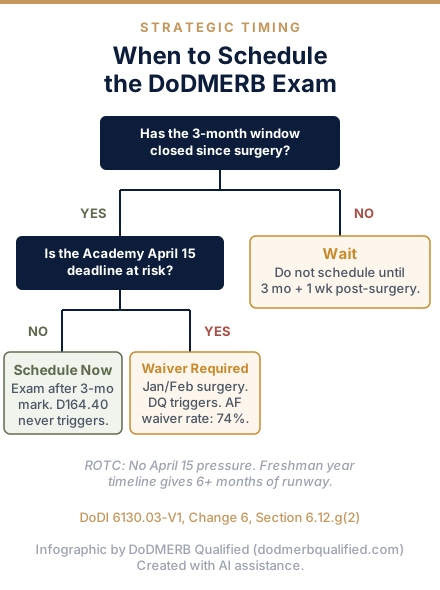
After this section, you have specific dates on your calendar and know whether timing avoids the DQ or triggers a waiver.
Related: DoDMERB Waiver Process: Complete Guide
Documentation Checklist: What to Gather Before the DoDMERB Exam
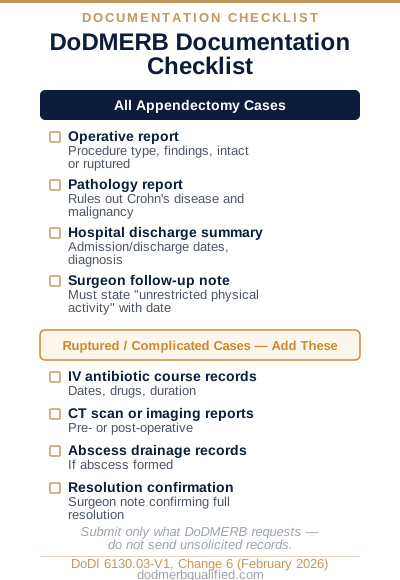
Request these four core documents from your surgeon's office as soon as your student has recovered. Having them organized at home means you can respond within days if DoDMERB issues a remedial request for additional medical information (AMI).
All Appendectomy Cases
- Operative report: describes the procedure, whether laparoscopic or open, what the surgeon found, and whether the appendix was intact or ruptured
- Pathology report: confirms the diagnosis was appendicitis and rules out Crohn's disease, malignancy, or other GI conditions (this document matters more than most parents realize)
- Hospital discharge summary: dates of admission and discharge, final diagnosis, discharge instructions
- Surgeon follow-up note: must explicitly state clearance for unrestricted physical activity with a specific date
Ruptured or Complicated Cases (in addition to above)
- IV antibiotic course records: dates, drugs administered, duration of treatment
- CT scan or imaging reports: any pre-operative or post-operative imaging
- Abscess drainage procedure records: if an abscess formed and required drainage
- Resolution confirmation: surgeon's note confirming complete resolution of peritonitis, abscess, or secondary infection
The pathology report deserves special attention. It confirms the diagnosis was straightforward acute appendicitis. If the pathology showed granulomas, transmural inflammation, or other atypical features, that flags a potential Crohn's disease connection, which changes the DoDMERB outcome entirely. More on that in the next section.
When your student completes the DD Form 2807-2 (medical history form), disclose the appendectomy completely: date, type of surgery, whether ruptured, any complications. Full disclosure with proper documentation reflects the integrity expected of a future military officer.
Do not submit character reference letters, coach letters, or non-medical documentation. These carry no weight in the DoDMERB process. Medical test results and physician notes are what matter.
After this section, you have a complete checklist and know exactly which documents to request from your surgeon's office.
DoDMERB Qualified
Not sure if your student's documentation is complete?
We review appendectomy cases against DoDMERB standards, identify missing records, and help you build a clean file before the exam.
When Appendicitis Is Not Just Appendicitis: The Crohn's Disease Risk
In 0.2% to 1.8% of appendectomy cases, what looked like appendicitis was actually Crohn's disease. For DoDMERB purposes, that distinction changes everything. A healed appendectomy is a 3-month temporary DQ. Crohn's disease is permanently disqualifying.
DoDI 6130.03 Section 6.12.c(1) states:
"History of inflammatory bowel disease, including, but not limited to, Crohn's disease, ulcerative colitis, ulcerative proctitis, or indeterminate colitis."
This maps to DQ code D161.40. Unlike D164.40, it does not expire with time. It requires a separate, more complex waiver process.
Clinical red flags that suggest Crohn's rather than simple appendicitis include chronic diarrhea before the surgery, unexplained weight loss, anemia, elevated platelet count, and blood in the stool. These symptoms are not present in typical acute appendicitis. If your child had any of them before or around the time of surgery, the pathology report becomes critical.
Pathology red flags include granulomas and transmural inflammation in the appendix specimen. If either appeared on your student's pathology report, schedule a gastroenterology consultation before proceeding with DoDMERB. A colonoscopy and blood workup can definitively rule out or confirm IBD. Ruling it out now is far better than having DoDMERB raise the question later.
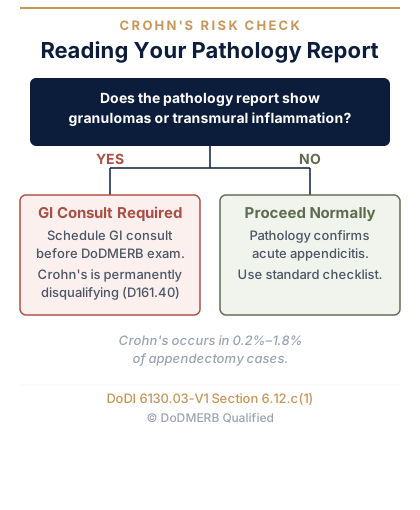
For the majority of readers, this section does not apply. If the pathology report shows straightforward acute appendicitis with no atypical features, move forward with the standard documentation checklist and timing strategy above.
If Crohn's is confirmed, a waiver is still possible but requires specialist documentation showing the condition is well-controlled and not progressive. That is a fundamentally different case than a simple appendectomy, and one where professional guidance becomes essential.
After this section, you know whether the Crohn's risk applies to your student and what to do if it does.
The Bottom Line
An appendectomy triggers DQ code D164.40, a time-limited disqualification that expires 3 months after surgery. There is no permanent disqualification for a healed appendectomy at any service academy or ROTC program.
The two variables you control are timing and documentation. Schedule the DoDMERB exam after the 3-month window closes and the DQ never triggers. If timing forces a DQ (January or February surgery with an April 15 Academy deadline), know that competitive applicants receive automatic waiver consideration. Air Force officer candidate waiver approval rates sit at 74% and continue trending upward. A healed appendectomy with clean documentation is among the most favorable waiver scenarios in the system.
The one exception: if the pathology report showed features of Crohn's disease, complete a gastroenterology workup before proceeding. That is a different case with a different DQ code and a different process.
Gather your documentation now. Time the exam strategically. If your student's case involves complications or tight timelines, we evaluate appendectomy cases against current DoDMERB standards and help families build a complete file before the exam.
Frequently Asked Questions
Will my child's appendectomy disqualify them from a service academy?
Not permanently. DQ code D164.40 expires 3 months after surgery. After that window closes, a healed appendectomy is not disqualifying at any academy or ROTC program. Time the DoDMERB exam after the 3-month mark to avoid triggering the code entirely.
How long should we wait after appendectomy to take the DoDMERB exam?
Wait 3 months plus 1 week from the surgery date. Confirm your student's surgeon has cleared them for unrestricted physical activity before scheduling. This margin ensures D164.40 does not trigger.
My child had a ruptured appendix. Is that treated differently by DoDMERB?
Same DQ code (D164.40), same 3-month rule. The documentation burden is higher. DoDMERB may request records confirming abscess resolution, antibiotic completion, and full recovery. See the documentation checklist above for the complete list.
Does my child need to disclose the appendectomy on the DoDMERB medical history form?
Yes. DD Form 2807-2 asks about all surgeries. Disclose completely, regardless of how long ago it occurred. Full disclosure with proper documentation reflects the integrity expected of a future military officer.
Does DoDMERB grant the waiver?
No. DoDMERB is an information conduit. It determines qualification status but does not make waiver decisions. Each Academy and ROTC program has its own waiver authority. For competitive applicants, Academies automatically initiate waiver consideration. Your student does not need to request it separately.