The email arrived, the medical questionnaire is open, and the application deadline suddenly feels like a countdown clock running against your student. Take a breath. The DoDMERB timeline runs roughly 2 to 4 months from authorization to a clean qualification, with about 6 to 8 weeks of that spent between the exam and a final determination. A waiver, if it comes to that, can add weeks to several months on top, with no published clock at all.
Here is the part that calms most parents down. Almost none of that calendar is in your hands. You are waiting on a medical contractor, a scheduling system, and a small team of case managers, none of which you control. That waiting is normal, even when the portal sits silent for weeks after the exams are done.
The few pieces you do own matter intensely. A handful of deadlines belong entirely to your family, and they are the one place where a missed step can quietly add 45 days or more, or force your student to restart the whole process. Knowing which clock is yours and which is the system's is the difference between productive patience and refreshing a portal at midnight.
This guide walks the process phase by phase, attaching a realistic, sourced duration to each one. It names the exact deadlines you are responsible for, answers the question every parent eventually asks (why is the portal not updating?), explains how a remedial or disqualification changes the timeline, and reassures you on the misconception that derails the most families: DoDMERB does not have to be finished by your application deadline.
Key Takeaways
- A clean DoDMERB path runs about 2 to 4 months; from exam to determination alone is roughly 6 to 8 weeks.
- Your family owns two hard deadlines: schedule exams within 5 days of authorization and complete them within 30 days, or the account goes inactive.
- A missed appointment without 24 hours notice triggers a No Show, which blocks reauthorization for at least 45 days.
- DoDMERB does not have to be complete by the application deadline. The safety target is final medical status by roughly March 1 of the entry year.
- After exams finish, results can take up to about 30 days to reach DoDMERB, then the case manager takes about 2 weeks, and your academy portal can still lag 2 months behind that.
The DoDMERB Timeline Phase by Phase
As of August 2025, the entire process runs on two separate systems, and that split is the source of most delays families experience. DMACS 2.0 (ready2serve.dmacs.health.mil) is the DoDMERB portal where your student completes the medical history questionnaire (DD Form 2807-2) and tracks status. DoDMETS (dodmets.com), operated by a civilian contractor called the CIV Team, is where exams get scheduled. Your student has to pass through both, and the handoff between them is where the clock often stalls.
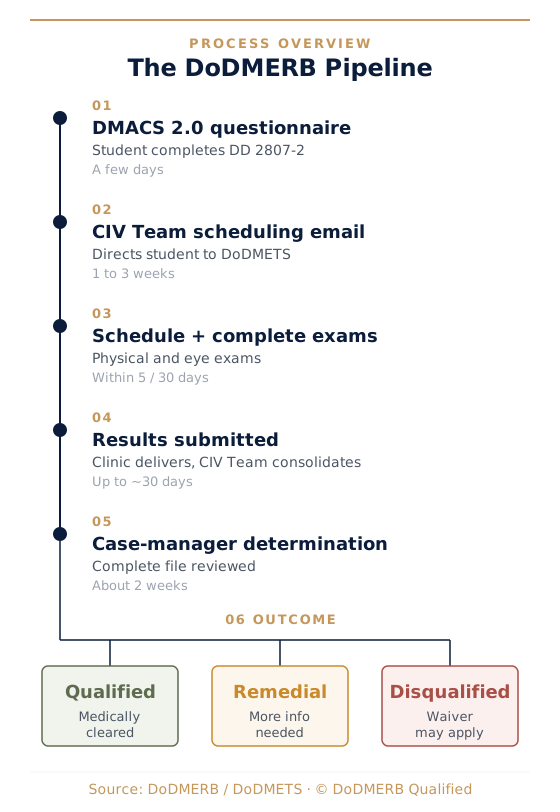
The table below maps each phase to a realistic duration and, just as important, to whose clock you are waiting on at that moment.
| Phase | What happens | Typical duration | Whose clock |
|---|---|---|---|
| Notification & registration | Program forwards your student; DoDMERB emails the DMACS 2.0 link; student registers and completes DD 2807-2 | A few days | DoDMERB / family |
| Questionnaire to scheduling email | CIV Team emails the student directing them to DoDMETS to schedule | 1 to 3 weeks | CIV Team |
| Schedule exams | Student books physical and eye exams (within 5 days) | Family deadline | Family |
| Complete exams | Both exams done (within 30 days); first available is often 2 to 4 weeks out | Family deadline | Family |
| Results submitted | Clinic delivers results; CIV Team consolidates and submits to DoDMERB | Up to ~30 days | Clinic / CIV Team |
| Determination | Case manager reviews a complete file and renders status | About 2 weeks | DoDMERB |
A few phases deserve more than the table can hold. The process formally runs as a thirteen-step flow on the DHA side, but families experience it as the six phases above. The first real wait comes right after the DMACS questionnaire. The email pointing your student to DoDMETS to schedule has been taking roughly one to three weeks to arrive since the 2025 rollout, partly because each new account is manually security-reviewed for access. That silence is normal, not a sign anything is broken.
Scheduling itself adds time even when your student acts fast. The first available appointment at a contracted clinic is often two to four weeks out, which is why booking inside a day or two of authorization, rather than waiting out the full five-day window, can pull the whole timeline forward.
Once exams are complete, the results enter a multi-week pipeline. The contracted clinic has up to 30 days to deliver them to DoDMERB, and the CIV Team consolidates the file within roughly 15 business days of receiving everything. Only when a complete file lands does the determination clock start, and a case manager typically renders a status within about two weeks if the queue is not backed up.
Why the waits at all? DoDMERB runs on roughly 30 staff who process about 45,000 examinations a year across five academies, four ROTC programs, and other commissioning paths. The backlogs are not arbitrary. They are a small team moving a large volume, which is exactly why protecting your own deadlines matters so much.
Related: What to Expect at Your DoDMERB Exam
The DoDMERB Deadlines Your Family Is Responsible For
Most of the DoDMERB timeline is waiting, but a few deadlines are entirely yours, and they are the only parts that can truly sink your student. Everything else is the systems' clock. These are not.
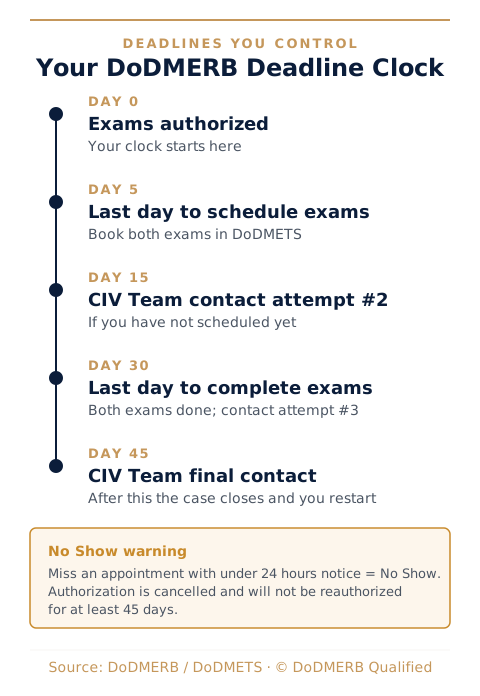
The first two are tight. Once DoDMERB authorizes exams, your student has 5 days to schedule them and 30 days to complete them. If the exams are not completed within 30 days, the account is flagged as inactive, which means chasing reactivation instead of moving forward.
The second clock is the contact sequence, and almost no other guide mentions it. The CIV Team will attempt to reach an unscheduled applicant up to four times: an initial contact, then again at 15 days, 30 days, and 45 days. After that fourth attempt passes without a scheduled exam, the case effectively closes and your student starts the process over from the beginning. Answering any one of those messages the same day keeps the case alive. A message that lands in a spam folder and sits unread is how families lose this one without ever realizing a clock was running.
Then there is the appointment itself. Missing a scheduled exam without at least 24 hours notice triggers a No Show designation, which cancels the exam authorization outright.
These are the avoidable delays. You cannot rush the case manager, but you can keep your own clock from costing your student months.
Deadlines to put on your calendar
- Schedule both exams within 5 days of authorization
- Complete both exams within 30 days of authorization
- Never miss an appointment without at least 24 hours notice
- Respond to any CIV Team contact the same day
After this section, you should have four firm dates on your calendar and know which single mistake can cost your student 45 or more days.
Why Your DoDMERB Portal Is Not Updating
The exams are done, days are passing, and the portal will not move. This is the moment more parents panic than at any other, almost always without cause. The fix is knowing where your student sits and which kind of wait you are looking at.
A clean case moves through a predictable sequence in DoDMETS before DoDMERB shows a final result. Locate your student on this list and the silence usually explains itself:
- Complete: the clinic has submitted the exam.
- Complete and On Hold: submitted, but something is pausing forward progress.
- Closed: the file has moved on from the scheduling system.
- Exam Reviewed: DoDMERB has the file and is reviewing.
- Qualified / Remedial / Disqualified: the determination.
Two of these get confused constantly.
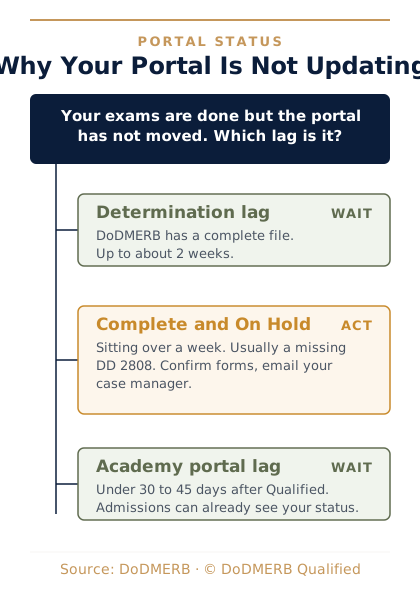
The first is the normal determination lag. Once DoDMERB has a complete file, a status update can take up to about two weeks. That is patience, not action.
The second is the trap. "Complete and On Hold" can sit for months, and the most common reason is a missing form, usually the DD Form 2808 the clinic failed to include. One family watched their student's file sit in this status for three weeks before discovering the DD 2808 was never sent. This status calls for action. If your student has been in it longer than about a week, confirm the clinic submitted every required form and, if needed, email the assigned case manager.
DoDMERB Qualified
Worried your student's file is quietly stuck?
LTC Kirkland reviews where your student's file sits and what is holding it, so you stop guessing and know your next move.
There is a third lag, and it is the most reassuring of all. Even after DoDMERB shows Qualified, the academy applicant portal can take two months or more to reflect it. This is normal. Admissions can see your student's medical status independently of the portal, so a blank or stale display does not mean the academy is in the dark.
Our daughter was DoDMERB-qualified in September, but the academy portal still read "incomplete medical examination" into November. We finally emailed admissions, and they confirmed her file was complete on their end the whole time. The portal just had not caught up. — reported by a service academy parent
The practical rule: do not contact admissions about a portal lag unless it passes 30 to 45 days. Below that, it is the file transfer catching up.
For a full reading of every status, see the DoDMERB portal guide.
After this section, you should be able to identify which of the three lags your student is in and whether it calls for patience or a phone call.
How a Remedial or Disqualification Resets the Clock
A remedial is not a denial. It is the case manager saying they need more before they can decide. Families see the word and assume the worst, but a remedial keeps the door fully open. It simply restarts the determination clock.
The formal term is AMI, Additional Medical Information or Additional Medical Service. When DoDMERB issues one, it is asking for a specific document, a specialist evaluation, or a test result. Once your student submits exactly what was requested, DoDMERB processes the response in about 15 business days, roughly three calendar weeks. Every additional loop adds another three weeks, which is why responding the same week, in the exact format requested, is the entire game.
A real example makes the math concrete. One applicant with a heart murmur was sent for an echocardiogram as additional medical information. That single loop added about a month, and the full process ran close to four months end to end. The delay was not the condition itself. It was the round trip of requesting the test, scheduling it, and submitting the result.
A disqualification works differently. A DQ, shown in the portal as DNMMS (Does Not Medically Meet Standards), does not so much reset DoDMERB's clock as hand the file to your student's program for a waiver decision. That is a separate timeline, covered in the next section. For the portal labels you will see: MMS means qualified, DNMMS means disqualified, and Remedial means more information is needed.
Related: Remedial vs Disqualification: What the Difference Means
How Long a DoDMERB Waiver Takes
Once a waiver is in play, DoDMERB is no longer driving the timeline. The commissioning program is, whether that is a service academy or an ROTC branch, and there is no standard clock for how long a decision takes. This is the honest answer families struggle to get anywhere else.
The two tracks behave differently from the start. ROTC scholarship files are automatically forwarded for waiver review after selection, so the student does not have to initiate anything. An academy, by contrast, first decides whether it even wants to pursue a waiver for a given candidate, and only competitive applicants typically see one moved forward.
Realistic ranges run from weeks to several months. Historically, backlogs at the waiver-authority level alone have reached up to 60 days. The table below sets honest expectations for each track.
| Track | Who decides | Typical timing | Note |
|---|---|---|---|
| Academy | Academy medical / waiver authority | Usually resolved before April 15 of entry year | Academy chooses whether to pursue |
| ROTC scholarship | Branch waiver authority | Roughly 60 days to 3 months | Auto-forwarded after selection; runway to roughly December of freshman year |
Lived cases show the spread. One family's waiver took about 3.5 months from a conditional acceptance to approval. A USMMA applicant saw roughly 12 weeks pass between the waiver request and the approval. Branch-level differences are real, since each academy keeps its own medical staff and policies, but the through line is the same: plan for a range, not a date.
For the full mechanics of how waivers are decided, see the DoDMERB waiver process guide and the breakdown of waiver authorities by branch.
What Families Can Do to Speed Up DoDMERB
You cannot speed up the case manager, but you can keep your own clock from costing your student weeks. Nearly every avoidable delay traces back to one of the items below. None of them are complicated, and all of them are in your hands.
Before you start
- Begin the moment your student is invited; do not wait for a quieter week
- Gather records matching every "YES" answer on the questionnaire before opening the survey
- Keep those records organized at home so they are ready if a remedial arrives
While scheduling
- Schedule within 1 to 2 days of authorization even though you have 5
- Take the first available appointment even if the timing is inconvenient
After exams
- Check the DoDMERB portal at the two-week mark once exams show Complete
- Respond to any remedial or AMI request within 24 to 48 hours, in the exact format asked
- Apply to multiple programs, since each has its own waiver authority
One note on disclosure. The DoDMERB process is self-reported: there is no system that pulls your civilian medical records automatically, so the review starts from what you put on the DD 2807-2. Full and accurate disclosure up front is still the strategy. A condition you leave off can surface later through records you are asked to provide or a future exam, and an unexplained gap creates delays and integrity questions. Disclose completely and document thoroughly.
After this section, you should have a short, concrete list of actions that protect the only parts of the timeline you actually control.
The Bottom Line on the DoDMERB Timeline
Plan for 2 to 4 months for a clean path, and longer if a waiver enters the picture, knowing the waiver has no standard clock. That single frame ends most of the anxiety, because it tells you what normal looks like before you start refreshing a portal.
Two reassurances matter more than any other. First, DoDMERB does not have to be finished by your application deadline. Submit the parts of the application your family controls on time, and let medical review run in parallel. The safety target is final medical status by roughly March 1 of the entry year, not the application due date.
Second, admissions can see your student's status even when the portal looks blank or stale. Medical clearance percolates right up to the end of the admissions cycle, and a silent portal is rarely a problem.
Spend your energy on the parts that are yours: the 5-day and 30-day deadlines, the same-week response to a remedial, the first-available appointment. Treat a remedial or a disqualification as a next step, not an ending. Most families who lose time lose it to a missed deadline or a panicked email, never to the medicine itself.
DoDMERB Timeline FAQ
How long does the DoDMERB process take from start to finish?
Expect 2 to 4 months from authorization to a clean qualification, with about 6 to 8 weeks of that between the exam and the determination. A remedial adds roughly three weeks per loop, and a waiver can add weeks to several months on top, with no standard clock.
How long after I finish both exams until my portal updates?
Results can take up to about 30 days to reach DoDMERB, then the case manager takes about 2 weeks to decide. You will see a Complete, Complete and On Hold, Closed, then Exam Reviewed sequence first. After DoDMERB shows Qualified, the academy portal can still lag two months or more.
Does DoDMERB have to be complete by the application deadline?
No. DoDMERB has no deadline tied to your application due date. The safety target is final medical status by roughly March 1 of the entry year. Applications proceed while medical review continues, and admissions can see your student's status independently of the portal.
What happens if I do not schedule my exams in time?
You have 5 days to schedule and 30 days to complete. The CIV Team contacts you at 15, 30, and 45 days if you have not scheduled, and after the fourth attempt you must restart. A no-show without 24 hours notice blocks reauthorization for at least 45 days.
What does Remedial or AMI mean for my timeline?
A remedial, or AMI, is not a disqualification. It means the case manager needs more information before deciding. DoDMERB processes your response in about 15 business days, so every loop adds roughly three weeks. Respond the same week, in the exact format requested, to minimize the delay.
Who controls the waiver decision and how long does it take?
The commissioning program, the academy or ROTC branch, controls the waiver, not DoDMERB. There is no standard timeline; expect weeks to several months. ROTC files are auto-forwarded after selection, while an academy decides whether to pursue one. Academy waivers usually resolve before April 15 of the entry year.
The appearance of U.S. Department of Defense (DoD) visual information does not imply or constitute DoD endorsement.