If your child has been diagnosed with spondylolysis or spondylolisthesis and is applying to a service academy or ROTC scholarship, the DoDMERB news is rarely what families expect. The diagnosis was likely framed by your treating orthopedist as routine, manageable, and consistent with a full return to sport. DoDMERB is asking a different question on a different timeline, against the demands of a 20 to 30 year career that may include parachute school, infantry training, and operational deployment under load.
Spondylolysis causes 47% of back pain in adolescent athletes, compared with about 5% in adult athletes. The cohort is predictable: female gymnasts, football linemen, wrestlers, weightlifters, and divers. Many cases are discovered incidentally on imaging done for an unrelated reason, sometimes years before any application is filed.
"USMA had already issued me a letter of assurance from admissions, on my academic, leadership, and athletic file. Separately, DoDMERB medically disqualified me for spondylolysis and spondylolisthesis — back problems I didn't even know I had. West Point requested a new orthopedic evaluation, and the spine specialist confirmed I had no limitations for any physical activity." DoDMERB Qualified case file
A letter of assurance is an admissions decision, issued by the academy's admissions board on the strength of the candidate file. It is not contingent on DoDMERB qualification and does not function as a medical waiver. Candidates routinely hold an LOA while still medically disqualified, and the academy can later request a waiver from its own waiver authority on a parallel track. A medical DQ does not revoke an LOA; conversely, an LOA does not guarantee a waiver.
A spondylolysis or spondylolisthesis diagnosis is disqualifying under current accession standards. That part is not negotiable, it does not depend on how your child feels today, and it does not expire. What is negotiable is the waiver, and five things shape it: the anatomy, the regulatory standard as it is actually written, the risk profile behind the diagnosis, what your imaging shows about current stability, and the documentation packet you assemble before DoDMERB ever asks for it.
Key Takeaways
- Any history of spondylolysis or spondylolisthesis is disqualifying under §6.16.k, congenital or acquired, symptomatic or not, at any grade. There is no time window that clears it.
- An incidental pars defect found on imaging years ago still triggers the standard, and so does one your child never had a symptom from.
- Spondylolysis is the cause of 47% of back pain in adolescent athletes vs. about 5% in adult athletes, and is concentrated in gymnasts, football linemen, wrestlers, and weightlifters.
- Other spine standards can stack on the same applicant, including recent treatment history, posterior arch fractures, and surgical fusion. Each is its own disqualification.
- Because the disqualification is effectively automatic on diagnosis, the entire case is the waiver, and the waiver rests on demonstrated current function and a stable spine.
- Each commissioning source (USMA, USNA, USAFA, Army ROTC, Navy ROTC, Air Force ROTC) holds independent waiver authority. A denial at one does not bind any other.
- The single most overlooked waiver document is a current orthopedic spine surgeon evaluation written specifically for DoDMERB, not a generic "cleared for sports" note.
The Two Conditions: What's Actually Happening in Your Child's Spine
These two diagnoses sound nearly identical, but DoDMERB treats them differently, and the difference comes down to a single piece of bone the size of a pencil eraser. Understanding the anatomy is the foundation for understanding the waiver path.
Spondylolysis: a stress fracture of the pars
The pars interarticularis is the weakest segment of the posterior vertebral arch, sitting between the superior and inferior articular processes. About 85-95% of spondylolysis cases occur at L5, with another 5-15% at L4.
The mechanism is repeated lumbar hyperextension combined with rotation under load, not a single traumatic event. It is accumulated microdamage from thousands of repetitions in a sport-specific motion pattern. About 80% of L5 spondylolysis cases eventually progress to isthmic spondylolisthesis if the defect does not heal.
Spondylolisthesis: when the vertebra actually slips
When the pars defect separates enough that the vertebra above slides forward over the one below, the condition becomes spondylolisthesis. The "isthmic" subtype is caused by a pars defect, and it is the type relevant to teen athletes.
Symptoms include lower back pain that worsens with activity and improves with rest, possible radiation to the buttocks or one thigh, hamstring tightness, and muscle spasm. Many patients are entirely asymptomatic and discover the slip on imaging.
Why the distinction matters clinically, and why it does not change the DQ
"History of spondylolysis or spondylolisthesis, congenital or acquired." — DoDI 6130.03-V1, Section 6.16.k
That is the entire standard. One sentence. It contains no time window, no symptom requirement, and no grade threshold. If either diagnosis appears anywhere in your child's medical history, the standard applies.
This is the point families most often get wrong, and the stakes are high. A pars defect that healed in ninth grade, never hurt, and has not been imaged since is still a history of spondylolysis. So is a slip so small the radiologist called it minimal. The disqualification fires on the diagnosis being in the record, not on how your child feels today.
| Condition | What's Happening | How DoDMERB Reads It |
|---|---|---|
| Spondylolysis | Stress fracture of the pars, vertebra stays in place | Disqualifying as a history under §6.16.k |
| Spondylolisthesis | Vertebra slips forward over the one below | Disqualifying as a history under §6.16.k |
| Healed, asymptomatic pars defect with no slip | Old injury, no progression | Still a history, still disqualifying, and it must be disclosed on DD 2807-2 |
Related: DoDMERB disqualification codes explained
After this section, you can explain the difference between spondylolysis and spondylolisthesis and explain why the standard applies to your child's case regardless of symptoms, grade, or how long ago the diagnosis was made.
Why DoDMERB Disqualifies Even Healed, Asymptomatic Cases
Your child's orthopedist signed off. Their imaging looks clean. They're back on the team without restrictions. DoDMERB still disqualified them, and that outcome confuses nearly every family we see. The medical accession standard is not asking the same question your treating doctor was asking.
The other spine standards that can stack on top
§6.16.k is not the only standard your child's record gets read against. Three others come up constantly in these files, and each is an independent disqualification.
The first covers recent conditions of the spine.
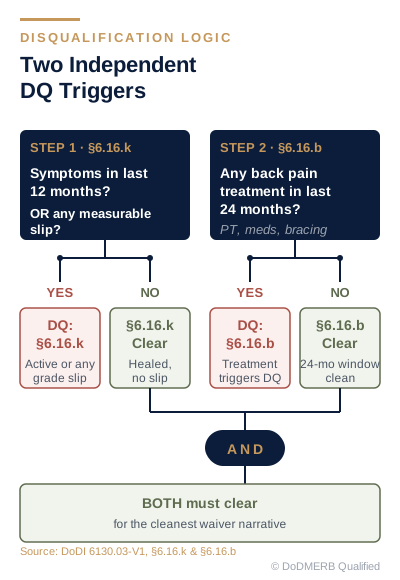
"History of any condition, in the last 24 months, or any recurrence, including but not limited to the spine or sacroiliac joints, with or without objective signs, if: (1) It prevented the individual from successfully following a physically active avocation in civilian life, or was associated with local or radicular pain, muscular spasms, postural deformities, or limitation in motion; (2) It required external support; (3) It required frequent treatment or limitation of activities of daily living or a physically active lifestyle; or (4) It required the applicant to use medication for more than 6 weeks. (5) It caused one or more episodes of back pain lasting greater than 6 weeks requiring treatment other than self-care. ..." — DoDI 6130.03-V1, Section 6.16.b
Two more subparagraphs follow the ones quoted above, covering spine surgery and interventional procedures such as spinal injections, nerve blocks, and radio ablation.
Reading a seven-part standard is tedious, so here is what it tends to mean for a teen athlete: a TLSO brace is external support, a course of physical therapy that limited daily activity is frequent treatment, and a back-pain episode running longer than six weeks that needed more than self-care is called out by name.
The second is the vertebral fracture standard, which matters here because a pars defect is a fracture of the posterior arch.
"History of vertebral fractures including: ... (2) Fracture(s) of elements of the posterior arch (i.e., pedicle, lamina, pars interarticularis)." — DoDI 6130.03-V1, Section 6.16.f
The third applies only if there was surgery.
"History of congenital fusion involving more than 2 vertebral bodies or any surgical fusion of spinal vertebrae." — DoDI 6130.03-V1, Section 6.16.d
The practical consequence is that the PT records showing your family did the right thing are also part of the disqualifying record. That is not a reason to leave them out. It is a reason to have them complete, organized, and paired with proof of where your child stands now.
Why accession standards look backward
The accession standard asks a different question than the one your child's orthopedist answered. The orthopedist asked whether this teenager can safely return to their sport this season. The accession standard asks whether an 18-year-old with this diagnosis in their file is a sound bet across a 20 to 30 year career that may include airborne training, a 12-mile ruck under load, or duty on a carrier flight deck.
That is why the standard is written as a history of. It is not measuring today. It is reading the record for anything that predicts a spine failing later, under loads no high school sport applies.
What "cleared" actually means
Treating physicians clear patients to return to their current activity level. They are not forecasting Ranger School, a 12-mile rucksack march under load, or carrier flight deck duty.
"Full clearance for sports" is medically appropriate for a high school athlete and entirely beside the point for DoDMERB. Reviewers read the record for a different signal: whether the defect is healed on the most recent imaging, whether the spine is stable across studies, whether any restriction is still in place, and whether anything suggests symptoms could resurface under sustained military loading.
After this section, you can explain to your student why a clean orthopedic discharge note does not by itself overcome the DoDMERB standard.
Why High School Athletes, Especially Gymnasts and Football Players, Get Diagnosed
If your child is a gymnast, football lineman, or wrestler, this diagnosis is not random. It is the predictable result of a specific mechanical loading pattern repeated thousands of times. Reviewers see it constantly, which is both why they recognize it and why they can evaluate it on its own pattern.
Highest-risk sports
Spondylolysis prevalence runs about 3-6% in the general population, 8-15% in elite adolescent athletes, and up to 47% in adolescents referred specifically for back pain evaluation. The condition concentrates in sports that combine hyperextension with rotational loading.
Female gymnasts and football linemen sit at the top of the risk list. Wrestling, weightlifting, swimming (especially butterfly), soccer, track, diving, and volleyball all show elevated rates. Back walkovers, blocking stances, snatches, butterfly strokes, and serving motions all combine lumbar hyperextension with rotation under load.
What this means for waiver framing
The diagnosis does not signal recklessness or poor decision-making. It signals participation in a sport that DoDMERB reviewers see frequently and understand mechanistically.
A waiver packet that provides sport context, injury mechanism, conservative treatment, and documented healing reads as a known pattern with a known resolution path. The strongest narratives show four elements in sequence: identified injury, conservative treatment (typically TLSO brace and physical therapy), follow-up imaging showing healing, and return to full baseline function with no current restrictions.
When the diagnosis is incidental
Up to 5% of children as young as six have a pars defect with no known injury, often found on imaging for unrelated reasons such as scoliosis screening or a single fall. Many academy and ROTC applicants discover the condition at their DoDMERB exam.
An incidentally discovered, never-symptomatic defect with no treatment history is still disqualifying under §6.16.k. What it is not is complicated. There is no treatment record to explain, no restriction to close out, and no recent episode to account for, so the packet is short and the narrative is clean. That is a meaningfully better starting position than a recently treated case, and it is the one place where an incidental finding genuinely helps.
Related: Scoliosis: military degree thresholds by branch
After this section, you can identify which risk profile your student fits and which waiver narrative applies to their case.
Reading the Imaging: What the Meyerding Grade Does and Does Not Decide
The Meyerding grade gets quoted back to us constantly, usually with the assumption that a low grade means a low chance of being disqualified. It does not work that way. The grade has nothing to do with whether the standard applies. It is clinical detail that a waiver authority may weigh once the disqualification is already on the table.
What the grade measures
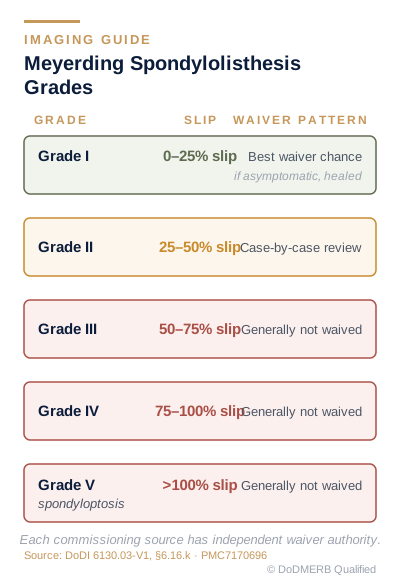
The Meyerding Classification measures forward slip as a percentage of the width of the vertebral body below the slipped vertebra. It is the standard orthopedic vocabulary for describing a slip, which is why it appears in the radiology report and why reviewers recognize it on sight.
| Meyerding Grade | Slip Percentage | Category |
|---|---|---|
| Grade I | 0–25% | Low-grade |
| Grade II | 25–50% | Low-grade |
| Grade III | 50–75% | High-grade |
| Grade IV | 75–100% | High-grade |
| Grade V (spondyloptosis) | >100% | High-grade |
Every grade in that table is disqualifying. So is a pars defect with no slip at all, which has no Meyerding grade to report. The grade describes the anatomy. It does not gate the standard.
Where it does matter is further down the line. A waiver authority evaluating an already-disqualified applicant is making a clinical judgment about spinal stability and durability under load, and the degree of slip is part of that picture, alongside whether the slip has progressed between studies. We do not publish approval rates by grade. We have not found a data source that would support one, and the numbers that circulate online are not traceable to any service's waiver data.
Each commissioning source (USMA, USNA, USAFA, Army ROTC, Navy ROTC, Air Force ROTC) has independent waiver authority, and each weighs the clinical picture against its own pipeline demands.
Healing stage matters as much as grade for spondylolysis
For pure spondylolysis with no slip, reviewers focus on healing status on the most recent imaging. CT shows it most clearly. An acute-phase defect is narrow with no surrounding sclerosis and has good healing potential. A chronic-phase defect is wide with marginal sclerosis and a 0% healing rate.
Pediatric healing rates by stage: very early stage 100%, early stage 93.8%, progressive stage 80%, terminal stage 0%.
On MRI, Hollenberg grades 1 through 3 indicate active injury with healing potential and bone marrow edema. Hollenberg grade 4 indicates a chronic, established non-union with no edema. A healed pars with no active edema is a strong waiver asset. An active injury is a waiver liability.
What actually strengthens the waiver case
Reviewers are looking for evidence that the spine is stable now and likely to stay stable. In practice that means a healed pars on the most recent CT, no progression of any slip between the earliest and most recent studies, no edema or active stress reaction on MRI, no current restrictions, and a documented return to full training load that has held.
Post-surgical cases, whether pars repair or fusion, are their own conversation. They depend heavily on the operative report, post-op imaging, and how long full function has been sustained. Above 50% slip, surgical management is the standard of care, so those files usually arrive with a surgical history attached.
We do not hand families a percentage. Anyone who does is guessing.
After this section, you can read your child's imaging report, identify the Meyerding grade and healing stage, and explain why neither one changes whether the standard applies.
What Waiver Reviewers Actually Evaluate
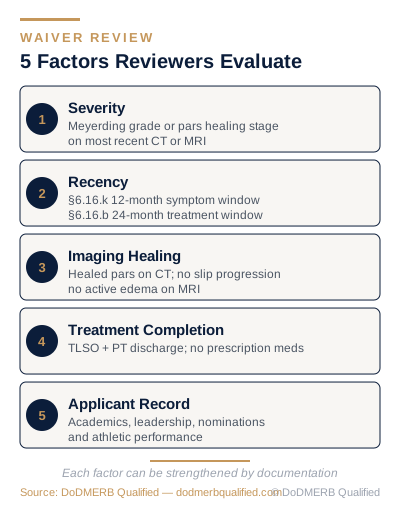
A waiver review is not a coin flip. It is a structured assessment of five specific factors, and every one of them can be influenced by what is in the documentation packet. Knowing the factors lets you build the packet that addresses each one directly.
Factor 1: Severity
For spondylolisthesis, the degree of slip and whether it has progressed between studies are the dominant variables. For spondylolysis, severity is a composite: presence of any slip, healing stage on the most recent imaging, and bilateral versus unilateral defect. Bilateral defects carry higher progression risk. Surgical history is reviewed case by case, with weight given to the operative construct and how long function has held since.
Factor 2: Recency
Recency is a waiver consideration, not a way out of the disqualification. Nothing about the passage of time clears §6.16.k. What time does is build evidence. A student who has been symptom free and treatment free for two years with an unchanged imaging picture has demonstrated something a student six months out of a brace has not. The §6.16.b window is separate and does run on a 24-month clock, so a file sitting just inside it carries a second disqualification alongside the first.
Factor 3: Imaging healing status
The most recent imaging carries the most weight. Older studies establish history. Reviewers want to see a healed pars on CT, no slip progression on weight-bearing flexion-extension lateral X-rays, and no edema or active stress reaction on MRI. An old study showing the original injury paired with a recent study showing resolution is the strongest two-part narrative.
Factor 4: Treatment completion
The packet should include a TLSO brace and PT history with end-of-treatment notes from the treating therapist. A PT discharge summary is not the same as a final PT note buried in a longer record. No current prescription pain medications. Occasional over-the-counter NSAIDs are acceptable. If surgery was performed, operative notes and post-op imaging confirming fusion or repair are essential.
Factor 5: Applicant competitiveness
Strong academic record, congressional nominations, leadership history, and athletic record all factor into how aggressively a program pursues a waiver. A borderline medical case for a top-quartile applicant receives more reviewer effort than the same case for a marginal applicant. A strong academic and leadership file is a medical waiver asset.
After this section, you can name the five factors a waiver reviewer evaluates and identify which factors your student's documentation already addresses.
DoDMERB Qualified
Not sure what your child's diagnosis means for their commissioning path?
We review your student's medical history against each service's waiver criteria and give you a realistic picture of which commissioning paths remain open.
The Documentation Packet: Exactly What to Gather Now
Incomplete documentation is the most common cause of preventable waiver denials, and almost every gap is fixable if you start now. Begin gathering before DoDMERB requests anything. If a Remedial request arrives, the packet is ready for submission through DMACS 2.0.
Organize records in the order reviewers read them: history first, then imaging, then specialist consult, then treatment, then current functional status. A clean narrative arc signals that nothing is hidden and nothing is missing.
Clinical records
Gather from every provider who treated your child for back pain or related symptoms
- Pediatrician visit notes referencing back pain or activity restriction
- Urgent care or ER notes (request from each facility separately, these are commonly missed)
- Sports medicine consultation notes
- Orthopedic clinic notes from initial visit through discharge
- Athletic trainer records if available
Imaging, chronological, with radiologist reports
Request the radiologist report, not just the image files
- All X-ray reports (AP, lateral, flexion/extension, oblique views)
- All CT reports
- All MRI reports (note any Hollenberg grade or "chronic pars defect" language)
- Bone scan or SPECT report if performed
- Most recent imaging study. If your last imaging is more than 6-12 months old, discuss requesting a current study with your child's orthopedist
Orthopedic spine surgeon consultation
Commission a current evaluation specifically for the DoDMERB record
The report must include:
- Injury history and how the condition was discovered
- Complete treatment and rehabilitation summary
- Current range of motion measurements
- Muscle strength testing results
- Neurological findings (reflexes, motor, sensory)
- Written confirmation of any current restrictions, or written confirmation of none
- Explicit functional capacity statement addressing physical training and military duty demands
Physical therapy
- PT initial evaluation
- PT end-of-treatment or discharge notes
- Home exercise program documentation if assigned
Medications and surgery
- Medication history with explicit statement that no prescription pain medications are currently used
- Operative notes if surgery was performed
- Post-operative imaging confirming fusion or repair if applicable
After this section, you have a complete checklist to gather records, request a current orthopedic consult, and assemble a packet that addresses every factor a waiver reviewer evaluates.
Frequently Asked Questions
Can my child get a DoDMERB waiver for spondylolisthesis?
The disqualification itself is effectively automatic on diagnosis, so the waiver is the entire question. Cases that are asymptomatic, stable across imaging studies, off treatment, and back to full activity carry the strongest evidence. Each source (USMA, USNA, USAFA, Army ROTC, Navy ROTC, Air Force ROTC) has independent waiver authority, so an outcome at one does not predict the others. We do not publish approval rates, by grade or otherwise.
My child is back to playing sports. Why is he still DQ'd?
Because §6.16.k disqualifies on history, not on current fitness. Your student's return to sport is real evidence and it belongs in the waiver packet, but it does not remove the diagnosis from the record. DoDMERB is forecasting career-long risk over 20 to 30 years of service, not scoring this season.
What is the difference between spondylolysis and spondylolisthesis?
Spondylolysis is a stress fracture of the pars interarticularis with no slip. Spondylolisthesis is the slip itself, when the upper vertebra slides forward over the one below. Roughly 80% of L5 spondylolysis cases progress to isthmic spondylolisthesis if the defect does not heal.
Does an asymptomatic pars defect found incidentally still trigger a DQ?
Yes. §6.16.k covers any history of spondylolysis or spondylolisthesis, congenital or acquired, with no exception for incidental or asymptomatic findings. This is the single most common misunderstanding we see. Disclose the finding fully on DD 2807-2, submit current imaging, and treat it as a waiver case from the start.
Can my child receive a waiver from one academy after a denial at another?
Yes. Each commissioning source holds independent waiver authority, and one denial does not bind any other. The same documentation packet should be submitted to every source your student is applying to so the cleanest possible record is in front of every reviewer.
How long does it take to gather medical records for a waiver?
Plan two to four weeks per facility, and submit requests in parallel rather than serially. Specify all clinical notes, all imaging reports (not just the image files), all PT documentation, and operative notes if applicable. Hospital records departments respond on their own schedule.
Will my child need a new orthopedic consultation?
Almost always yes. Reviewers want a current functional capacity statement that addresses military training demands specifically, and most treating orthopedists never wrote one. The new consult covers ROM, strength, neurological exam, current restrictions, and an explicit statement on physical training tolerance.
What if my child had spinal fusion surgery?
A surgical fusion of spinal vertebrae is independently disqualifying under §6.16.d, on top of §6.16.k. Post-surgical cases are reviewed case by case. The packet should include the operative notes, post-op imaging confirming fusion, a current functional capacity statement, and documentation of full return to activity without restriction. Outcomes vary by branch and accession source. The waiver bar is higher than for a non-surgical case but it is not a categorical no.
The appearance of U.S. Department of Defense (DoD) visual information does not imply or constitute DoD endorsement.